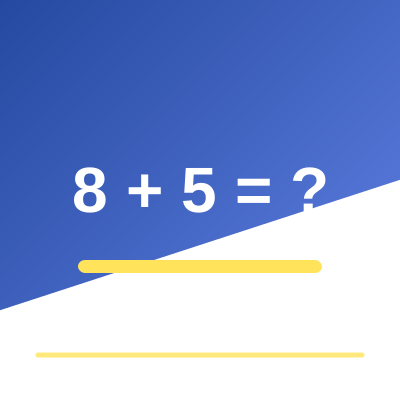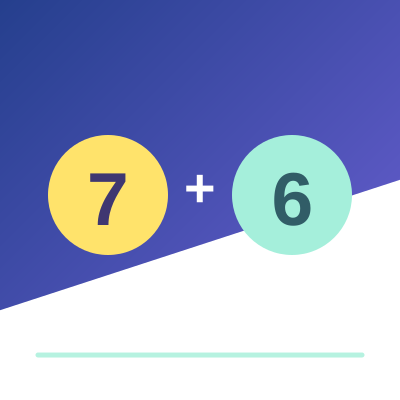
Number Forge Daily
Mental Math
Quick arithmetic games.
No games found. Try another search.
Mental maths games ask you to work out an answer before reaching for a calculator or a written method. They can be quiet puzzles, short quizzes or timed challenges, depending on the game. Math Sprint is a playable choice in this collection: Easy uses addition and subtraction, while Medium and Hard introduce multiplication and larger numbers. Speed Sums Daily and Number Forge Daily are also selected for this topic; check their game cards for current availability and rules. Choose the level and pace that fit what you want to practise.
The phrase mental maths games covers more than fast recall. A player might count on, split a number into tens and ones, use a known double, or reverse an operation to check an answer. Those methods are useful because they still work when the numbers change. If 8 + 7 is awkward, make ten with 8 + 2, then add the remaining 5. If 15 − 7 is awkward, count up from 7 to 15. A game is most useful when it leaves you enough room to notice which method you used.
Some people want a mental maths challenge with a score; others want time to think through a problem. Math Sprint has ten questions and a possible score of 100. Read the operation sign before choosing an answer. On a phone, check the answer buttons; on a computer, you can use the mouse or number keys. A quick run is useful for spotting facts you know immediately and questions that need a second look. Repeating a round is practice, but it does not prove mastery of every arithmetic topic.
Mental addition can start with number bonds. Knowing that 6 and 4 make 10 helps with 16 + 4 and with 26 + 14. Counting on is another route: for 28 + 5, move two to 30, then three more to 33. For subtraction, think about distance as well as taking away. To find 52 − 48, count from 48 to 50 and then to 52. That is a difference of four. These examples show why two different-looking questions may use the same small facts.
Try estimating before you answer. If a question is 39 + 21, the answer should be close to 40 + 20, or 60. An option near 600 can be rejected without exact calculation. With 63 − 29, you might subtract 30 to get 33, then add one back to reach 34. This compensation method works because 29 is one less than 30. In a multiple-choice game, use the choices to check reasonableness, not as a substitute for calculating.
Mental multiplication is easier when a fact can be built from one you know. If 6 × 7 is unfamiliar, 5 × 7 is 35 and one more group of 7 gives 42. Division can be checked with multiplication: if 42 ÷ 6 = 7, then 7 × 6 must equal 42. These links matter in mental maths games because a prompt may switch from one operation to another without warning. Pause long enough to identify whether you need a total, a difference, a product or a number of equal groups.
The current Math Sprint levels do not amount to a complete times tables course or a dedicated division game. The Multiplication and Division categories describe those topics more closely, and new game cards will say what their questions actually cover. If you came looking for mental maths games KS2 pupils might use, choose by number range and operation rather than assuming a school label guarantees the right difficulty. Year groups are broad; one player may need smaller facts while another wants multi-step questions.
A useful first run is untimed practice away from a score, even if you later choose a timed game. Say the answer and one reason for it. For example, 9 + 6 is 15 because one from six completes ten and five remains. Then try the same fact in a new setting, such as 19 + 6. If you cannot explain a result, slow down and rebuild it with a number line or counters. Speed follows familiarity more reliably than guessing does.
For mental maths games for kids, a short session can be enough. Start with operations they recognise and stop after a few careful answers if concentration fades. An adult can ask, “How did you see that?” without turning every mistake into a test. Mental maths games for the classroom may also work as a shared discussion prompt, but this site currently provides browser games, not a classroom lesson plan or printable worksheet. A teacher should review each playable game and its controls before using it with a group.
Mental maths games online often use US wording such as mental math games. The underlying arithmetic is the same, but UK players may also search for KS1 or KS2 practice, while US players may think in Grades. Neither label replaces the actual question on screen. A child who understands pairs to ten may be ready for Make Ten in Addition; someone who wants mixed operations can choose Math Sprint. Comparing these two playable games is more useful than promising a large catalogue that has not yet been built.
Math Sprint is the playable mixed-arithmetic option. Begin on Easy if you want smaller addition and subtraction questions. Make Ten, linked from Addition, is another starting point if number bonds to ten are the main goal. It has no timer. Both are free browser games, but they ask you to think in different ways: one presents a short series of answers, the other asks you to match number cards.
Notice a relationship behind each fact. Make ten, use a double, split tens and ones, or check division by multiplication. After a wrong answer, redo the calculation slowly and say where the first attempt changed direction. If the number range is too large, return to a simpler level for a while. A score can show progress in one round; your explanation shows whether the method is becoming more secure.
No. Check each card and the game page for its actual rules and controls. Math Sprint has a short question set and scoring; Make Ten has no countdown. Speed Sums Daily and Number Forge Daily have their own formats, so read their instructions before starting. A young player may need an adult to choose suitable numbers and check the controls. An older player may still benefit from a simple game if it exposes a gap in a basic fact.
As the collection grows, the useful distinction will remain the same: choose a playable game whose operations and pace match your goal, then use its feedback to decide what to practise next.