Battle Math
Decimals
Decimal numbers and place value.
No games found. Try another search.
Decimal games deal with place value to the right of the decimal point. MathUwU Decimals and the Decimal mode in Battle Math are selected for this collection; check their cards for current availability and how to reach the decimal questions. The guide explains tenths, hundredths, ordering, rounding and the link to fractions and percentages. These ideas help you recognise the challenge you need. Search results for decimal games online also include printable cards and apps; this site focuses on browser games, not a download library.
In 3.47, the 3 is in the ones place, the 4 represents four tenths and the 7 represents seven hundredths. A hundred-square can show 0.47 as forty-seven shaded squares out of one hundred. A place-value chart makes the decimal point a boundary between whole-number places and fractional places. A good visual puzzle would ask the player to connect a written decimal with the amount it represents. The Decimal Grid idea is aimed at this connection, but its final gameplay has not been published.
Decimal place value games can also show that adding a zero at the end does not change an amount: 0.5 = 0.50. The first number names five tenths; the second names fifty hundredths. They reach the same point on a number line. This is different from moving the decimal point, which changes the value. A player who can explain the place of each digit is less likely to treat a longer decimal as automatically larger.
Which is greater, 0.7 or 0.65? Rewrite 0.7 as 0.70. Seventy hundredths is greater than sixty-five hundredths, so 0.7 is greater. This step is useful in decimal comparison games where the answers look similar. Start with the whole-number part, then compare tenths, then hundredths. Stop at the first place where the digits differ. The order of the digits matters, not how many characters appear after the point.
Decimal number games may place values on a number line. Between 0.4 and 0.5 lies 0.45, halfway between them. Between 1 and 2 lies 1.5. Moving values on a line helps show both order and distance. It can also reveal an impossible answer: a number greater than one cannot sit between 0.2 and 0.8. If a game offers drag controls, check that the scale and labels are readable on the device you are using.
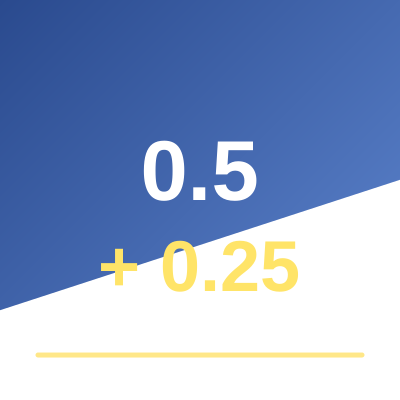
One half equals 0.5; one quarter equals 0.25. These are not separate topics competing for attention but different representations of the same proportion. Fraction to decimal games may ask you to match 1/4 to 0.25, while a percentage task might add 25%. The Fractions category provides a related explanation. A decimal page should make this bridge clear without implying that every game here contains conversion questions.
Money and measurement provide familiar decimals. £2.50 is two pounds and fifty pence. A length of 1.25 metres is one metre and twenty-five hundredths of a metre. The places still have the same mathematical meaning, even though the units differ. A player who can connect a grid model to a price or a ruler reading has a stronger understanding than one who only memorises the notation. Check a game's instructions before assuming that it uses either of these contexts.
For 0.3 + 0.4, add three tenths and four tenths to get seven tenths, or 0.7. For 0.35 + 0.2, rewrite 0.2 as 0.20, then add to reach 0.55. Keeping like places aligned helps prevent 0.35 + 0.2 being mistaken for 0.37. Decimal addition games can practise this, but there is no dedicated playable decimal addition here yet. The same care applies to subtraction: 0.8 − 0.25 becomes 0.80 − 0.25 = 0.55.
Rounding decimal games ask a different question. To round 3.46 to one decimal place, look at the hundredths digit, 6, and round the tenths up: 3.5. To round to the nearest whole number, look at 0.46 and reach 3. These rules are easier to use when you know which place the question names. Check a game's instructions for the requested place; a player should not have to infer it from an answer list.
Decimal games KS2 searches often involve tenths, hundredths, comparing and simple calculations. US searches may use fourth, fifth or sixth grade. A label is only a rough guide. Decide whether you need a picture of tenths, a number line, a conversion or an operation. Begin with one representation you understand and then connect it to another. For example, shade fifty squares on a hundred-grid, write 0.50 and then explain why it equals 0.5 and 1/2.
MathUwU Decimals presents decimal questions, while Battle Math has a Decimal mode reached from its own menu. Check their pages for the actual rules and current availability. The site also has Make Ten for number bonds and Math Sprint for mixed arithmetic, but neither is a dedicated decimal game. Their links can help if a player wants a different kind of maths practice.
It asks the player to understand what a digit represents according to its position, such as tenths or hundredths. A grid, chart or number line can make that value visible. Use the questions in MathUwU Decimals or Battle Math to practise decimal calculations, and use a drawn place-value chart if the relationship between digits needs explaining.
No. Fifty hundredths and five tenths are equal, so both numbers mark the same point on a number line. The extra zero can be useful when aligning decimal places for comparison or calculation. It does not make the amount larger. A good comparison game should let the player see that equivalence rather than just mark an answer correct.
Yes, by connecting pictures and values such as 1/2 with 0.5 or 1/4 with 0.25. That connection is a useful learning goal, but do not assume every decimal game here teaches conversion. Read each game’s rules to see whether it covers both subjects. The Fractions category explains the equal-parts side of the relationship.
When decimal games are ready here, their cards will describe the actual place values and actions involved. Until then, use this guide to decide which representation is worth practising next.