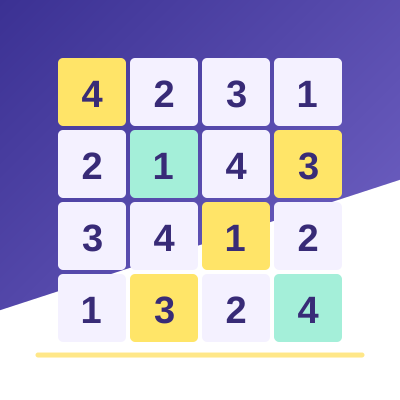
Calcudoku
Logic Puzzles
Grids, clues and deductions.
No games found. Try another search.
Logic puzzle games ask you to use clues and rules to rule out impossible answers. Lights Out and Calcudoku are selected for this category; check their cards for current availability and instructions. The guide below explains deduction, grids, sequences and checking a solution, so you can recognise the style of puzzle you want. Some searches for logic puzzle games lead to phone apps, board games or downloads; this collection focuses on free browser play.
Suppose three people each choose a different colour. You know that Alex did not choose red and that Bea chose blue. Bea is settled; the remaining colours belong to Alex and the third person. The first clue then fixes Alex's colour if only one option remains. This small example shows the core move of a logic grid puzzle: record what is known, mark what is impossible and use the remaining spaces to deduce an answer. Guessing may reach the right choice once, but a logical explanation works again with a new set of clues.
Logic puzzle games for kids can begin with two or three attributes, such as person, colour and object. More difficult puzzles add categories or clues that must be combined. A clue may tell you directly that one pairing is true, or indirectly that two things cannot go together. When a grid contains several categories, keep your markings consistent. If one item is assigned in a row, every other pairing for that item must be excluded. The value of the grid is that it prevents the same possibility being reconsidered repeatedly.
An example of a fact is “the blue box is not on the left.” A deduction is “therefore the blue box must be on the right” if there are only two positions. A guess is “I think it is on the right” without enough information. A game may let you test a guess, but that does not make it a deduction. Before selecting a final answer, ask which clue supports each step. This habit catches a common error: assuming that because one arrangement feels likely, the other arrangements are impossible.
Online logic puzzle games sometimes reveal feedback after every move; others show only a result at the end. Both can be useful. Immediate feedback helps a beginner find an error, while delayed feedback encourages a full chain of reasoning. Lights Out and Calcudoku use different rules, so check each game's instructions for the way it handles moves, clues, checking and completion.
A code puzzle may ask you to infer a hidden sequence from clues about position or value. The rules must be precise. A hint that “two digits are correct” is different from “two digits are correct and in the right places.” Read exactly what a game tells you before changing your next guess. Lights Out instead uses a changing grid of lights, while Calcudoku combines number constraints with arithmetic. For other spatial deduction, see Geometry.
Pattern questions require care too. The list 2, 4, 6, 8 suggests adding two, but several mathematical rules could fit four numbers. A fair puzzle needs enough context to make its intended rule reasonable. If a game asks for the next number, try explaining the change between each pair and checking whether the rule works throughout. A puzzle that merely accepts one number without explaining the rule may be entertaining, yet less helpful for learning how to reason.
Free logic puzzle games range from compact clue grids to spatial challenges and number riddles. A player looking for logic puzzle games for adults may want more categories, longer chains and fewer hints. A younger player may prefer small grids and visible objects. Those descriptions are broad: read the real instructions for Lights Out and Calcudoku before choosing a difficulty. A free game should not require players to infer essential rules from repeated failed attempts.
If you are choosing among topics, Calcudoku combines row and column constraints with arithmetic. Geometry can involve visual properties and symmetry. Counting helps with small sets before more complex grids. These related categories provide different entry points; follow their cards and game instructions to choose a task that fits the player.
After filling a logic grid, read every original clue again. Check that each category item has one partner where the puzzle requires one-to-one matching. If a clue says a person did not choose red, your completed grid must still respect that statement. One unchecked contradiction can make an apparently complete grid wrong. When working with a code, test every clue against the proposed sequence, including positions and counts. This check is part of solving, not an optional extra after the congratulation screen.
If you get stuck, look for the clue with the fewest remaining possibilities. Combine it with a row or column where several choices have already been eliminated. Mark one certain fact, then reconsider the others. Avoid changing many guesses at once, because you will not know which change caused progress. This is a practical method you can use in a paper puzzle now and in a browser puzzle later.
They are games where rules and clues let you deduce an answer. A grid records possible and impossible states, while an arithmetic puzzle may constrain several cells at once. Lights Out and Calcudoku are selected examples with different controls and reasoning styles. Read their pages for the exact rules before starting.
They overlap, but not every logic puzzle requires arithmetic. Matching people to objects from clues can be solved by elimination without calculation. A number puzzle may require sums, sequences or factors. Some games use both kinds of reasoning. Choose by the actual rule set rather than a broad category label.
Trace each choice back to a clue or a deduction from earlier clues. Then test the completed answer against all the original statements. If two different answers still satisfy everything, the information you have used may not be enough, or one clue was missed. A reliable puzzle should let you explain why the answer must fit.
When these games are ready, this page will distinguish their real formats and levels. Until then, use the examples to decide whether deduction, patterns or spatial reasoning are the kind of challenge you want.