Timescaler
Time
Clocks, hours and minutes.
No games found. Try another search.
Play telling the time games online. Clock Master focuses on reading and setting an analogue clock, while Timescaler mixes clock, calendar and elapsed-time questions.
The short hand points towards the hour. The long hand shows the minutes. At 3 o'clock, the long hand points to 12 and the short hand points to 3. At half past three, the long hand points to 6 and the short hand has moved halfway between 3 and 4. The hour hand does not jump to the next number all at once; it moves gradually. A clock game that shows this movement can help a learner avoid reading half past three as half past four.
Telling the time games for kids often begin with whole hours and half hours. Later, each number around the clock marks five minutes for the long hand: 1 means five minutes, 2 means ten, and so on. It helps to count those minute steps aloud before trying a faster matching challenge. If the minute hand is on 3, it is fifteen minutes past the hour, or quarter past. On 9, it is forty-five minutes past, often described as quarter to the next hour.
An analogue clock at quarter past seven corresponds to 7:15 on a digital display. Quarter to seven is 6:45, because fifteen minutes remain before seven. These phrases can be confusing if a player looks only at the number closest to the hour hand. Ask which hour has already passed and which is coming next. In Clock Master, the clock face is the centre of the question: read its hands or set them to a given time. Timescaler also includes clock questions alongside other time skills.
The 24-hour clock continues after midday: 3:30 pm is 15:30, while 3:30 am remains 03:30. Twelve noon is 12:00, and midnight is 00:00 in standard 24-hour notation. A finished game should say whether it works with 12-hour time, 24-hour time or both. Search results for telling time games free may refer to US wording without “the”; the underlying clock skill is the same. UK learners may search for telling the time games KS1 or KS2 instead.
Reading a clock gives a time of day. Elapsed time asks how long passes between two times. From 2:20 to 3:05, count forty minutes to 3:00 and five more minutes to 3:05, giving forty-five minutes. You can also draw a timeline with two jumps. A game that asks “What time is it?” and one that asks “How long until?” practise related but different skills. Check a card's task before assuming it covers both.
For longer intervals, separate hours and minutes. From 09:40 to 11:10, move twenty minutes to 10:00, one hour to 11:00 and ten minutes to 11:10. The total is one hour and thirty minutes. Counting in convenient jumps is easier to explain than subtracting clock digits as if they were ordinary base-ten numbers. Sixty minutes make an hour, so the boundary matters. A number line or clock-face animation can help make the jumps visible.
A beginner may need to recognise o'clock and half past. Another player may be ready for five-minute intervals, the nearest minute or a timetable question. Search terms such as telling the time games online and telling time to the half hour games describe different tasks. A UK school-year label is a broad indication, not a promise of an exact level. Adults should inspect a playable game's clock style and question format before giving it to a child.
Time is also a measurement. Seconds, minutes, hours and days describe duration, while a clock face describes a time of day. If you want to practise the face itself, start with Clock Master. If you want to move among clocks, calendars and elapsed-time problems, try Timescaler. Duration questions can also be written as short stories. For now, use the two playable Time games here and read each prompt to distinguish a time of day from a length of time.
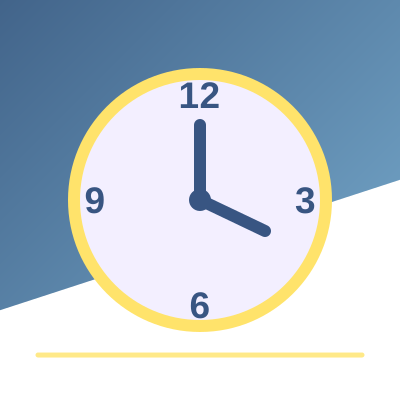
Start with a paper clock or an analogue clock whose hands you can move. Set 4:00, then move the minute hand halfway around and observe where the hour hand goes. Next show 4:15 and 4:45. Say each time in words and write it digitally. Then ask how long it takes to move from one to another. This sequence connects the picture, language and calculation before any score is involved.
Clock Master has twelve levels described by its publisher. Some ask you to read an analogue clock; others ask you to set its hands. The first level opens with a clock and three answer choices. Timescaler begins with a climber and a peak, then presents questions about clocks, calendars and elapsed time. These are distinct experiences: choose Clock Master for focused clock-face practice or Timescaler for a wider mix of time questions. Each game has its own instructions and controls on its page.
Identify the short hour hand and long minute hand, then practise whole hours. Move to half past only when the movement of the hour hand makes sense. Quarter past and quarter to come next. Clock Master lets you begin with an early level before moving to more demanding clock questions. Timescaler can be the follow-up when you want to combine that skill with calendar and duration reasoning.
Quarter past is fifteen minutes after an hour, so quarter past six is 6:15. Quarter to is fifteen minutes before the next hour, so quarter to six is 5:45. Look at the long hand's position and then ask which hour the short hand is approaching. Saying the digital time as a check can help.
No. Some games ask you to read a clock face; others ask how many minutes pass between two times. A timer in a quiz does not by itself make the quiz a clock-learning game. Clock Master concentrates on reading and setting hands, while Timescaler mixes clock, calendar and elapsed-time questions.
Choose one time skill, read the question carefully and explain your answer. Start with a Clock Master level for the face itself, or a Timescaler peak for mixed practice.