Timescaler
Time
Read an analogue clock or set its hands to match a time across the publisher's twelve levels.
Some games take a moment to load. If the screen stays blank, or open it on the publisher’s site.
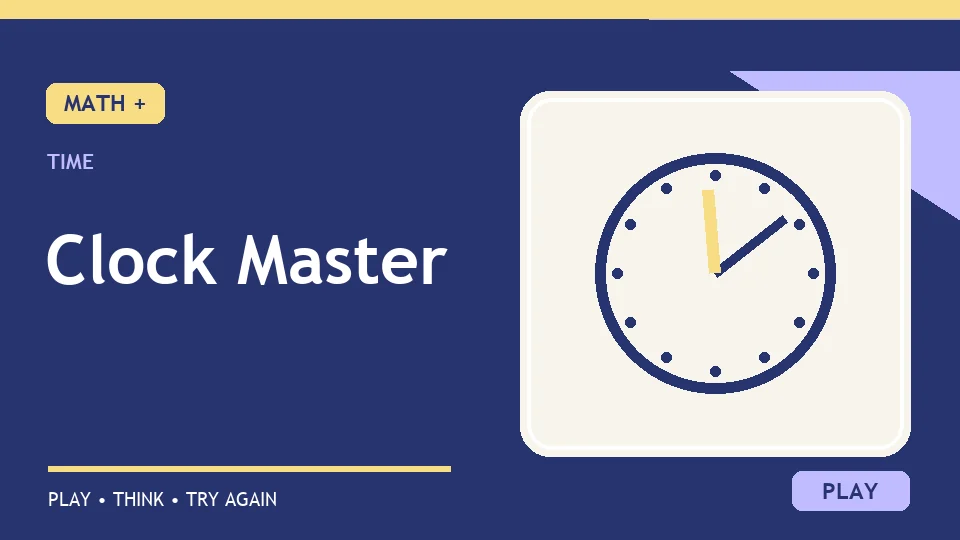
Clock Master is a browser game for reading an analogue clock and setting its hands. The publisher describes twelve star-rated levels, with questions that ask you to read a clock face or move the hands to show a given time. Its title is shared with unrelated products online, so the game on this page is identified by what it actually does: it turns the hour hand, minute hand and clock face into a series of time questions.
On an analogue clock, the shorter hand indicates the hour and the longer hand indicates the minutes. At exactly 3:00, the minute hand points to 12 and the hour hand points to 3. As minutes pass, the hour hand moves gradually towards 4. At 3:30 it is halfway between 3 and 4, not frozen on 3. This movement is easy to miss when a question asks you to choose between 3:30 and 4:30. Look at where the short hand has come from and where it is heading.
Each number around the face marks five minutes for the long hand. Starting at 12, the 1 means five minutes past the hour, the 2 means ten, the 3 means fifteen and the 6 means thirty. Count in fives to read a hand that points exactly at a numbered mark. If it rests between two marks, count the minute ticks from the nearest known mark. A minute hand at the 9 shows forty-five minutes past, which is also a quarter to the next hour.
The publisher's questions may present a clock to read or a digital time to construct. In either direction, use the same two checks: where should the minute hand go, and how far into the hour should the shorter hand have moved? For 7:15, the minute hand points at 3 and the hour hand is just past 7. For 7:45, the minute hand points at 9 and the hour hand is nearer 8 than 7. If you put the hour hand exactly on 7 at 7:45, the face does not represent the gradual movement of a real clock.
“Quarter past” means fifteen minutes after the hour. “Half past” means thirty minutes after. “Quarter to” means fifteen minutes before the next hour, or forty-five minutes past the current one. These phrases can be checked by counting the spaces between the 12 and the minute hand. One quarter of a sixty-minute turn is fifteen minutes. Half a turn is thirty. Three quarters is forty-five. Learning the geometry of the face makes the phrases less like separate facts to memorise.
The digital form is a useful cross-check. If the clock shows the minute hand at 6 and the hour hand between 10 and 11, the digital time is 10:30. If it shows the long hand at 11 and the short hand nearly at 2, the digital time is 1:55. The short hand's position stops you from misreading the second example as 2:55. Say the time in both forms before choosing an answer: “five to two” and “1:55” describe the same moment.
Some clocks use twenty-four-hour notation outside the game. On a twelve-hour clock, 2:00 can be in the morning or afternoon; a label such as a.m. or p.m. supplies that context. The clock face alone does not distinguish 02:00 from 14:00. If a question includes a.m., p.m. or a digital display, use the extra information. Do not invent it when the pictured clock provides only the hands.
First, identify whether the task asks you to read or to set the time. Second, locate the short hand and name the current hour. Third, count the minutes using the longer hand and the five-minute marks. Fourth, check whether the short hand's position agrees with that minute count. Finally, answer or adjust the hands. This sequence is slower than an immediate guess, but it catches a common error: reading the number under the long hand as the hour.
If the level asks you to drag the hands, move one hand at a time and inspect the result before submitting it. A small movement of the minute hand can change the answer by several minutes, while the hour hand must show progress through the hour. The game interface can change. If a hand is hard to grab on your device, try a wider display or use a pointer before deciding that your clock reading is wrong.
The star rating can encourage another try, but accuracy is more important than speed. A learner can pause after a wrong answer and compare the shown face with the intended digital time. Which hand was mistaken? Was the five-minute count wrong, or did the hour hand's partial movement go unnoticed? Naming the mistake makes the next question easier. A parent or teacher can ask a child to explain the reading in two steps, hour first and minutes second, instead of giving the answer.
The Time games collection also has Timescaler, which mixes clock, calendar and elapsed-time questions. Clock Master focuses on the clock face and hand movement. If a question asks how long an activity lasted, the Word Problems collection can help practise turning a story into a calculation. These are related skills, but a duration answer and a clock reading are not the same thing.
Which is the minute hand? The longer hand. It completes one turn in sixty minutes; the shorter hour hand completes one turn in twelve hours.
Why is the hour hand between two numbers? Time has passed since the earlier hour. At half past, it sits about halfway towards the next hour.
What does the 6 mean for minutes? When the minute hand points at 6, thirty minutes have passed since the hour.
Does a clock face show morning or afternoon? Not by itself. Use any a.m. or p.m. label supplied with the question.
Clock Master lets you check a reading immediately and try a new face. Count the minute marks, watch the slow movement of the hour hand and connect the clock to words you already use, such as half past and quarter to. Those habits carry beyond the game to timetables, appointments and everyday planning.
Start a level. Identify the short hour hand and longer minute hand, then choose the matching time or move the hands to match the prompt.
Controls: Select an answer or drag the clock hands, depending on the level. Read the prompt and check the shorter hour hand against the longer minute hand.