Shikaku
Geometry
Shapes, angles and space.
No games found. Try another search.
Geometry games ask you to notice shape, size, direction and position. Shikaku and Slitherlink are selected as spatial puzzles for this collection; check their cards for current availability and rules. This page is about mathematical geometry games, not the rhythm platform game Geometry Dash that often dominates searches for “geometry games”. Use the guide to decide whether you want to practise 2D shapes, 3D solids, angles, symmetry or coordinates. For deductive spatial play, you can also visit Logic Puzzles.
A triangle has three sides and three vertices. A quadrilateral has four sides. Within the quadrilaterals, a square has four equal sides and four right angles; it is also a rectangle because it has four right angles. This kind of relationship can be more useful than memorising a silhouette. A shape may be rotated or drawn in a different colour and still keep its defining properties. Shape-sorting games can test whether a player relies on those properties rather than on one familiar picture.
Geometry games for kids can start with matching and sorting. Ask whether each shape has straight or curved edges, how many corners it has and whether its sides are equal. Then compare two examples that look similar. A long thin rectangle and a square are not the same shape, although both have four right angles. A rhombus can have four equal sides without having the square's right angles. These comparisons give a reason for a choice on screen rather than a guess based on colour.
A flat drawing is two-dimensional: it has length and width. A cube is three-dimensional: it also has depth. Pictures of cubes are still drawn on flat screens, so a good game needs to make the faces, edges and vertices clear. Six square faces meet to form a cube; a sphere has a curved surface instead of flat faces. Identifying a solid from a picture may require imagining what is hidden behind it. Turning or building a model off-screen can help when a static image is confusing.
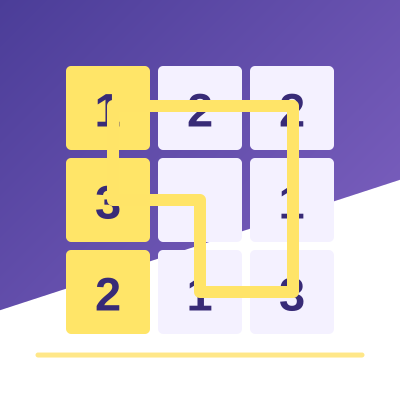
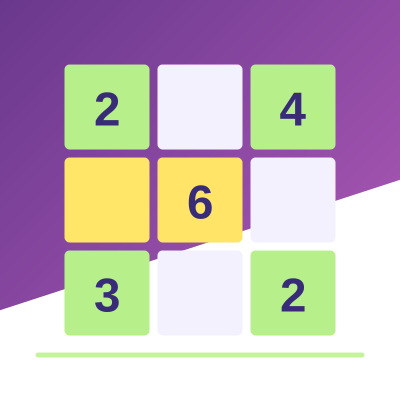
2D shape games online sometimes include sorting polygons, tracing lines or completing patterns. 3D shape games may ask which nets fold into solids. Shikaku asks players to partition a grid into rectangles, while Slitherlink uses a single closed loop around a numbered grid. Neither is a general shapes or 3D solids course. Read each game page for its exact task and controls.
An angle measures a turn between two rays. A right angle is a quarter turn, or 90 degrees. An acute angle is smaller than a right angle; an obtuse angle is larger than a right angle but smaller than a straight angle. A common mistake is to judge an angle by how long its arms look on screen. Lengthening an arm does not change the turn. Angle games are useful when they force a player to look at the opening rather than the decorative size of a drawing.
These two selected geometry puzzles do not present a dedicated angle-measurement lesson. If you need to identify acute, right or obtuse angles, fold a corner to make a reliable right-angle reference, then compare other turns with it. This can make the terms feel less arbitrary when they appear in another game or classroom task.
A line of symmetry divides a figure into mirror halves. A square has several lines of symmetry; a generic rectangle has two. A rotated shape keeps the same symmetry even if its outline looks unfamiliar at first. Geometry puzzles may ask you to complete a reflection or decide whether a pattern matches across a line. Checking corresponding points one by one is more reliable than saying that a design “looks nearly right”.
Coordinates locate a point by following an ordered pair, usually across and then up on a grid. The point (3, 2) is not the same as (2, 3). A game using coordinates should show its axes and scale clearly; without them, a player may learn the wrong rule from the interface. Shape, angle and position are related geometry topics, but they are not interchangeable. Follow Number Puzzles or Logic Puzzles if your main interest is deduction rather than properties of space.
Free geometry games may range from early shape recognition to advanced construction. UK searches often use shapes games, symmetry games and angle games; international searches may use grade levels instead. An age label can help narrow a search, but read the task itself. A beginner may need to sort circles from triangles. Another player may want to reason about interior angles or coordinates. Do not expect both to be offered by one small browser game.
Shikaku and Slitherlink provide two different ways to reason about space and boundaries. Shikaku uses rectangular regions; Slitherlink asks for a loop that satisfies clues. Use physical paper shapes, folded lines and a ruler or protractor to test the other geometry ideas described here. A browser game should add clear feedback and interaction, not simply repeat a list of shape names. Counting squares can also help when checking a grid area.
No. Here the word geometry means mathematical work with shapes, angles, symmetry and position. Geometry Dash is a separate named entertainment game. Search results mix the two meanings, so this page makes its subject clear. We do not claim to host Geometry Dash or any version of it.
Choose a task that shows a few clear shapes and asks about one property at a time: sides, corners, straight edges or curves. Rotate the same shape to check whether the child still recognises it. Shikaku and Slitherlink require careful grid reasoning, so a paper sorting activity may be a better starting point for a beginner.
Compare it with a right angle. If the turn is smaller than 90 degrees, it is acute. If it is larger than 90 degrees but smaller than a straight angle, it is obtuse. Ignore the length of the arms. Shikaku and Slitherlink focus on grids and boundaries rather than naming angle types.
Pick a geometry topic you can describe in words before choosing a card. The best feedback from a game will help you explain why a shape or boundary fits a rule.