Slitherlink
Geometry
Divide a numbered grid into rectangles; each rectangle must contain one clue and the matching number of cells.
Shikaku asks you to divide a numbered grid into rectangles. Each rectangle must contain exactly one clue, and its area in cells must equal that number. Every cell must belong to a rectangle, with no overlap and no gap. That makes the puzzle a practical exercise in rectangular area: a clue of 6 could occupy a 1 × 6 strip or a 2 × 3 block, provided the shape fits the board and contains no other clue. The version played here is hosted directly on Math Games and opens immediately on a playable board. It has no advertising, account screen or third-party cookie prompt. Choose a board, then drag across cells to draw each rectangle. The grid changes as you work, so a tentative rectangle affects the space available to every other clue.
Begin with a clue near an edge or corner. A corner cell can be covered only by a rectangle that reaches that corner. If a 3 sits near it, the rectangle can only be one cell by three cells, in one of the directions that fits. A 4 might make a line of four or a two-by-two square. The number gives the area, not the exact dimensions; finding the dimensions is the puzzle. Instead of colouring four cells at random, list the factor pairs of the clue. For 6, consider 1 × 6 and 2 × 3. Then look at the grid boundary and neighbouring clues to eliminate shapes that cannot fit.
The whole board is a useful check. On a 4 × 4 Practice grid there are sixteen cells. If its clue numbers add to sixteen, the rectangles have exactly enough total area to fill it. That does not solve the puzzle, because those areas still have to fit in the right places, but it explains why overlap is impossible. Covering a cell twice would leave another cell uncovered. When a proposed rectangle blocks a different clue from getting its required area, revise the proposal before filling more cells.
A rectangle must contain exactly one printed number. Suppose a 6 could be drawn as a 2 × 3 shape, but that shape would include a printed 2. It is invalid even though its area is correct. The 2 needs its own rectangle. Similarly, a long strip that passes through another clue cannot be part of the first clue's region. Check the cells inside each proposed boundary, not just its width and height. This rule often settles a shape faster than calculating every possible position.
Prime clues have fewer factor pairs. A rectangle with area 5 can only be 1 × 5 or 5 × 1 in whole cells. If the board is too narrow for one orientation, only the other is possible. A clue of 7 is even more constrained on a small grid. A composite clue such as 12 offers 1 × 12, 2 × 6 and 3 × 4, though the board may eliminate most of them. This is why the publisher suggests starting with prime numbers and edges: they reduce the number of shapes you need to inspect.
Select the clue and assign cells that form a complete rectangle. An L-shaped patch with the right number of cells is not allowed. A shape of six cells arranged as three across and two down is valid; five cells plus a corner sticking out are not. After each move, look at the remaining blank cells. Could they be divided into rectangles for the remaining clues? A narrow one-cell corridor may be useful for a clue of 3 or 5, but it may make a nearby 4 impossible if no two-by-two square or four-cell strip can reach it.
It helps to work from constraints instead of the largest number. A large clue can look attractive because it occupies many cells, yet it may fit in several ways. A small clue trapped against an edge can have only one viable shape. Fill the most constrained region first, then revisit the larger one. If two placements seem possible, hold both in mind briefly rather than committing to whichever looks neatest. The rest of the grid can act as the test.
The built-in selector offers six boards from 5 × 5 to 10 × 10. Start with Tatami 5 × 5 while learning how area clues restrict each rectangle. Move to a larger board when you can explain why a rectangle is forced rather than simply trying shapes. Every bundled puzzle has been checked by the game solver to have one complete solution.
A short routine can build confidence. First, identify every clue's factor pairs. Second, mark clues whose shapes are restricted by the board edge. Third, place one rectangle and recheck the neighbouring clues. Finally, inspect any empty pocket before the board is almost full. This order avoids the common mistake of filling most of the board and discovering that a two-cell gap cannot belong to the only remaining clue of 3.
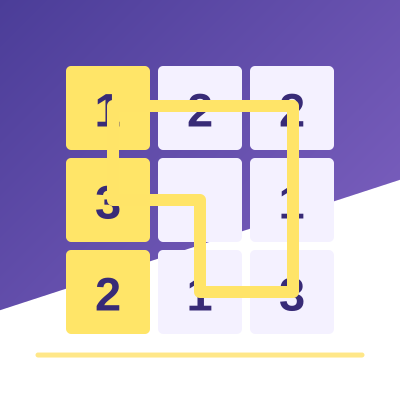
The rules use area, rectangles and the way shapes cover a plane. The arithmetic is modest, but it is important: the clue 6 equals the number of unit squares in its rectangle. Players repeatedly connect a multiplication fact, such as 2 × 3 = 6, to a spatial shape. The Geometry games collection brings together activities where shapes and space drive the challenge. Slitherlink is a different grid puzzle: it asks you to trace one loop along edges instead of dividing cells into rectangles. If number constraints are your favourite part of Shikaku, Logic Puzzles offers other ways to reason from printed clues.
Can a rectangle contain two clues if its area matches one of them? No. Every rectangle must contain exactly one printed number. The other clue needs its own region.
Can a six-cell region be L-shaped? No. It must be a rectangle, such as 1 × 6 or 2 × 3, if that shape fits on the board.
What should I do when a corner is blank? Check which nearby clue can reach it with a rectangle of the required area. Corners and edges often rule out otherwise plausible shapes.
Does finishing most cells mean the solution is close? Only if every remaining clue can still claim a rectangular area and all blank cells can be covered. A single trapped square is evidence that an earlier placement needs revision.
Shikaku rewards patient elimination. The clue tells you how many cells belong together; the board tells you which dimensions and positions are possible. When every rectangle has one clue, the correct area and a place beside its neighbours, the grid becomes a complete tiling rather than a collection of guesses.
The board is ready as soon as the page loads. Drag across neighbouring cells to form rectangles. Each rectangle must contain exactly one clue and its area must equal that clue. Cover every cell exactly once, with no overlaps or gaps.
Controls: Drag across cells to draw a rectangle; click a placed rectangle to remove it. Use Board to change puzzle, Hint for one forced rectangle, Clear to restart and Solve to reveal the complete tiling.