Sequence Daily
Number Puzzles
Number mazes and sequences.
No games found. Try another search.
Play number puzzle games online with patterns and ordered grids. Sequence Daily asks you to find a missing term; Hidato Number Path asks you to fill a connected path of numbers.
Consider 3, 6, 9, 12. Adding three each time gives the next term, 15. Now consider 3, 6, 12, 24. Here each term is doubled, so the next is 48. The first two terms alone do not reveal which rule is intended. Number sequence games should provide enough terms or context for a player to justify a choice. After you spot a pattern, test it against every gap, not only the last one. A rule that explains just one move may be a coincidence.
Some sequences mix operations or use shapes to show growing amounts. Square numbers go 1, 4, 9, 16 because they can be arranged in 1 by 1, 2 by 2, 3 by 3 and 4 by 4 arrays. Seeing that model is more informative than memorising the list. Other puzzles count in twos, tens or halves. Free number puzzle games can be entertaining, but a clear explanation of the rule makes the thinking reusable when the next sequence looks different.
A target-sum puzzle gives you several numbers and asks you to combine them to reach a goal. If the target is ten and the first number is seven, the missing partner is three. Make Ten is an addition example on this site. The two games in this Number Puzzles collection take a different route: Sequence Daily asks you to find a rule behind a line of values, while Hidato Number Path asks you to place consecutive values in touching cells. Choose the rule you want to practise before opening a game.
Missing-number questions can be written as 8 + ? = 13 or 20 − ? = 12. The first unknown is five, and the second is eight. The visible operation gives you a route: count on, count back or use an inverse fact. Sequence Daily sometimes makes the operation itself the puzzle: compare several gaps before entering the missing term. Hidato is different again. You already know the order of the numbers, but must deduce where each belongs. The word “puzzle” covers both, so read the instructions on the game page before playing.
In a number maze, each step might change your total or require you to follow a rule. For example, start at five and take a path labelled +3, then ×2: the total becomes sixteen. Reverse the order and you would get thirteen instead. This shows why reading the route matters. A maze is not merely about reaching the exit visually; the numbers on the route determine whether a move is allowed or whether a target can be reached.
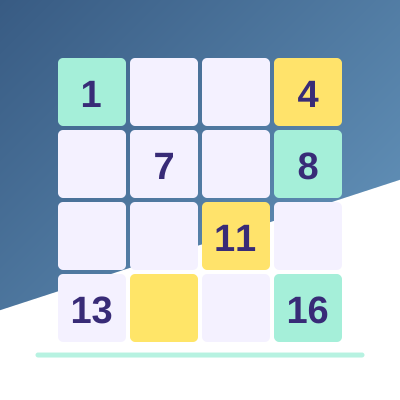
A numbered path needs a clear movement rule. In Hidato, consecutive numbers touch horizontally, vertically or diagonally. The first and last numbers are fixed, and the other printed values act as anchors. Before placing a number, look for cells that touch its predecessor and successor. If two anchors differ by two, the missing number must fit in a cell touching both. The Practice board lets you try this reasoning on a small grid and undo a tentative step when it blocks the rest of the path.
Estimation helps narrow choices before exact calculation. If a route must reach about fifty and one branch multiplies your current total of twenty by three, that branch will overshoot unless later moves can reduce it. Working backwards can be even stronger. If a final step is +4 and the target is 18, the previous value must be 14. Continue undoing steps to see whether the start fits. This is the same inverse reasoning used in Algebra and Addition, presented in a puzzle setting.
When a number puzzle gives multiple answers, check the completed route or sequence from start to finish. A single matching end value can hide an illegal intermediate move. Write or say the rule in one sentence: “I added four each time,” or “I multiplied by two, then subtracted three.” If you cannot state the rule, test another possibility before submitting. This habit is especially valuable in number grid puzzle games with several constraints.
Sudoku uses placement rules for rows, columns and boxes; ordinary Sudoku does not ask you to add the digits. A number sequence asks for a relationship between values. A logic grid may use names or colours without numbers at all. These categories overlap in reasoning but offer different actions for the player. Someone searching for number puzzle games for adults may want a larger grid or more complex chain, while a child may want a short, visible pattern. Read a playable game's own page rather than assuming a label defines its difficulty.
Searches such as number match online or named phone apps can have a specific product in mind. We do not claim to host those products. Likewise, free printable number puzzle games suggests a worksheet, which this browser collection does not offer. Here you can play a sequence game or a numbered path puzzle in the browser. Use the game titles and descriptions to decide whether you want to infer a numerical pattern or trace a route through a grid.
Take the numbers 2, 5 and 8 and choose a target, such as 15. Can you use each number once with addition to reach it? Yes: 2 + 5 + 8 = 15. Change the target to 11 and ask which two numbers make it: 3 would be needed with 8, but 3 is not available. This kind of small constraint teaches you to check the set of allowed moves. You can also invent a sequence, write four terms and ask someone else to explain its rule. If several rules fit, add another clue.
For browser play now, Make Ten offers a real target-sum puzzle. It uses pairs totalling ten and has no timer. Math Sprint offers a short arithmetic quiz, but it is not a sequence or maze game. These links give visitors a working path while the dedicated Number Puzzles cards are being developed.
They are puzzles where numbers form part of the rule or the answer. On this page, Sequence Daily asks you to complete a number pattern, while Hidato Number Path asks you to fill an ordered path through a grid. Both are playable in the browser.
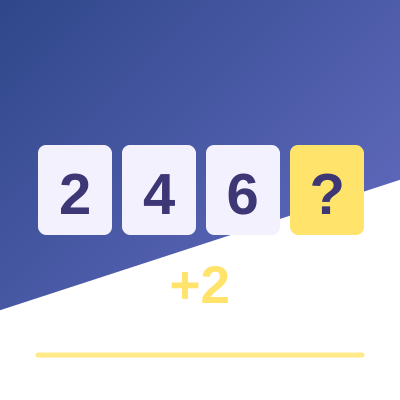
Compare each neighbouring pair and test a possible operation across the whole list. Check whether the change is addition, multiplication, alternation or a visual pattern. Do not rely on only the first two terms. If more than one rule could fit, look for another clue or term. A good answer includes the reason, not just the next number.
It is a number-placement logic puzzle. The digits are symbols placed under row, column and box rules; standard Sudoku does not require arithmetic. It belongs in its own category here because the solving method differs from a target sum or number maze. If you want calculation, choose a game that actually asks you to combine or compare values.
The strongest next puzzle is one whose rule you can explain and check. Start with a Practice round in Sequence Daily or a small Hidato board, then explain why your answer fits every clue.