Hidato Number Path
Number Puzzles
Find the rule behind a number sequence and enter its missing term in a daily puzzle or Practice mode.
Some games take a moment to load. If the screen stays blank, or open it on the publisher’s site.
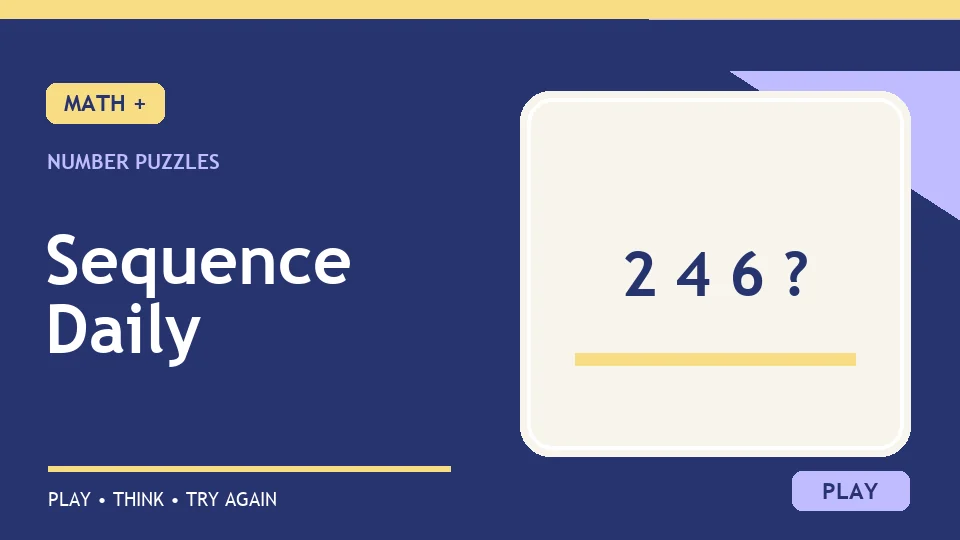
Sequence Daily is a number pattern game. Each puzzle shows a sequence with one value missing. Your job is to work out the rule and enter the number that belongs in the gap. The rule may involve adding or subtracting the same amount, but a quick glance is not always enough: a run of numbers can also hide a change in the size of the steps. In the version linked here, the publisher offers a daily set of five puzzles and a Practice mode. Practice is a sensible place to begin because you can test your method without treating the daily score as the whole point of the exercise.
Start by comparing neighbours that you can see. In `4, 6, 8, 10, ?`, the gaps are +2, +2 and +2, so 12 is the next term. In `−5, −13, −21, −29, ?`, each step is −8; the next value is −37. These are examples of sequence rules; your Practice questions can show different numbers. Writing the change between terms is more dependable than looking at the last number and typing whatever feels likely.
The signs matter. From −4 to 0 is a change of +4, not −4. The same +4 continues from 0 to 4 and from 4 to 8, making 12 the next term. If negative numbers make a puzzle look unfamiliar, put them on a mental number line. Moving four places to the right remains an increase whether you start below or above zero. A missing term can also sit in the middle; then check the rule from both sides before you submit it.
Some number sequence games use a rule more involved than one repeated addition. If the numbers are `2, 5, 10, 17, ?`, the gaps are +3, +5 and +7. The gaps themselves rise by two, so the next gap would be +9 and the next term 26. This is a method for reasoning about possible patterns; it is not a claim that this exact question appears in Sequence Daily. When the visible gaps are unequal, calculate a second row of differences before deciding that the sequence is random.
Another useful check is multiplication or division. For `3, 6, 12, 24, ?`, adding 3, 6 and 12 does describe the observed jumps, but multiplying each term by two gives a shorter, more consistent rule. That would make 48 the next term. A good answer should fit the entire visible run, not only the last pair. If two rules seem to fit a short run, look for a clue in the game's explanation after the attempt and compare it with your own reasoning.
Alternating patterns can be especially deceptive. Consider `1, 4, 2, 8, 3, 12, ?`. Reading every other position gives `1, 2, 3, ?` and `4, 8, 12`; the next term is 4. These examples show how to inspect a sequence, not a catalogue of this publisher's question bank. The safe habit is to try simple consecutive differences first, then separate odd and even positions only when the first method fails.
The daily format gives a limited number of attempts on each puzzle. The publisher describes warmer or colder hints and an explanation after a daily question. A hint is useful when it changes what you examine: perhaps your proposed number is too high, or perhaps the operation you used does not extend across every term. Do not keep entering nearby values without a rule. Return to the start of the sequence, write down every gap, and test a candidate across the whole line.
Practice can be less pressured. Choose a Practice level to open a sequence and enter your answer. Correct answers bring feedback and points. Use that mode to check whether you can explain the rule before you press the answer button. If you get one wrong, state the rule you tried, identify which transition disproves it, and attempt a new rule. That is more useful than memorising the displayed answer, because the next puzzle will show different numbers.
First, read the terms aloud, including minus signs. Second, find the change from one visible term to the next. Third, ask whether that change repeats. Fourth, if it does not, inspect the changes themselves or split the sequence into alternating positions. Finally, apply the proposed rule to every visible transition and only then fill the gap. This takes a little longer than a guess, but it makes each answer explainable.
For younger players, an adult can ask, “What happened between these two numbers?” without supplying the operation. That question keeps the work with the player. For an older learner, ask for two possible rules and a reason to prefer one. Sequences are a good way to practise arithmetic, signed numbers and noticing structure, but they are not a timed test of intelligence. A missed term is an opportunity to find the step where the reasoning stopped fitting.
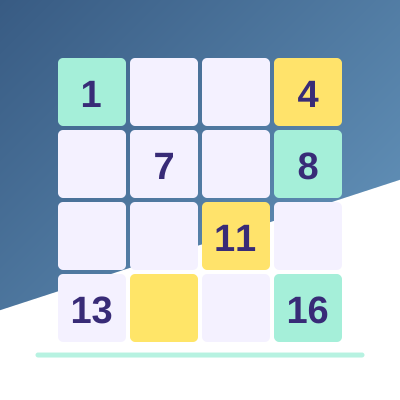
The Number Puzzles collection is about clues, patterns and the order of numbers. Sequence Daily focuses on the relationship between consecutive terms. Hidato Number Path uses consecutive numbers in a different way: you place them in touching cells rather than predict the next value in a line. If you would rather practise quick operations than inspect a pattern, the Mental Math collection is a better next stop. These links point to related ideas, not interchangeable rules.
This game can support a quick classroom warm-up or a quiet solo puzzle. The daily set is shared, while Practice supplies a way to work through a sequence without waiting for tomorrow's question. The visible game is embedded from the publisher, so its interface, availability and question set can change. Check the current controls in the frame before beginning, especially on a phone where the answer area may take more space than the number line.
Is every puzzle an addition sequence? No. Check subtraction, multiplication, changing differences and alternating positions when a single addition step does not fit all visible terms.
What if two answers seem possible? A short list can sometimes support more than one mathematical rule. Prefer the simplest rule that explains every term, then use the game's feedback and explanation to learn which rule the puzzle intended.
Do negative numbers change the method? No. Calculate signed differences carefully. A move from −4 to 0 is +4, just as a move from 4 to 8 is +4.
Should I guess to use all my attempts? You can submit an uncertain answer, but a reasoned attempt teaches more. Record the gaps first; the daily format's limited tries make that especially helpful.
Sequence Daily rewards careful observation. A number is convincing only when the same idea explains the whole sequence. Whether you solve the daily set or try Practice, look for a rule you could describe to someone else and use the result to improve your next deduction.
Choose Daily or Practice. Compare the visible terms, test the rule across the whole sequence, then enter the missing number. Daily puzzles allow limited attempts and provide feedback.
Controls: Choose Daily or Practice, pick a level, and use the on-screen keys to enter the missing term.