Sequence Daily
Number Puzzles
Fill a numbered grid so consecutive values touch horizontally, vertically or diagonally in one ordered path.
Some games take a moment to load. If the screen stays blank, or open it on the publisher’s site.
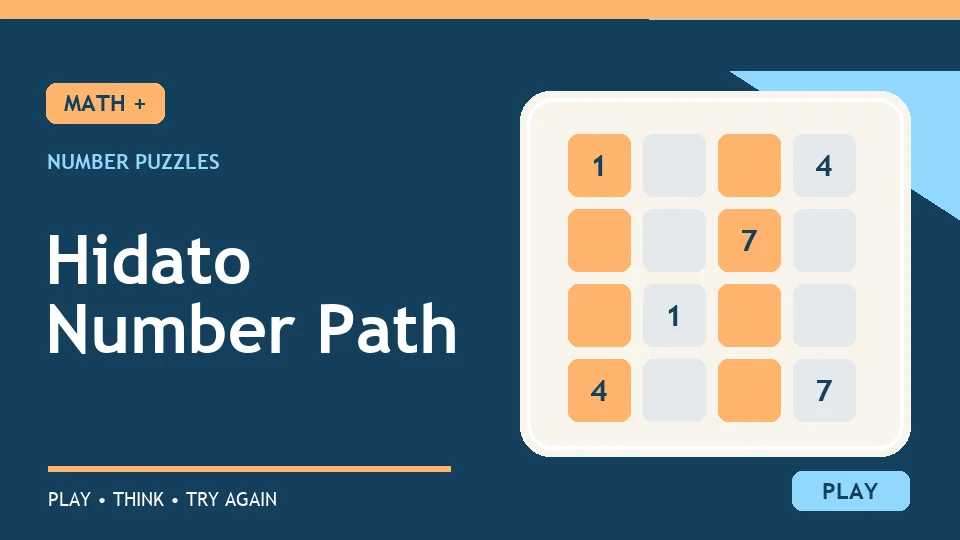
Hidato Number Path is a grid puzzle about counting in order. The first and last numbers are fixed, and some numbers between them are already printed. Fill the remaining cells so that every integer from the first to the last appears once. Consecutive numbers must touch, and a touch can be horizontal, vertical or diagonal. The finished board is therefore one continuous path, even though the path can bend in every direction. This version is supplied by Guessr Games and includes a Practice mode.
Hidato does not ask you to calculate a sum. It asks where the next number can live. Suppose 8 is fixed in a corner and 9 is missing. The possible positions for 9 are only the cells that touch 8 on that board. A corner has fewer neighbours than a central cell, so it often makes a strong starting point. If 10 is also fixed, 9 must touch both 8 and 10. Intersect those two neighbourhoods and you may have only one cell left.
Diagonal contact is easy to overlook. On a square grid, a cell can have as many as eight neighbours: the four that share an edge and the four that share a corner. The puzzle accepts the diagonal step. A path that seems blocked when you look only left, right, up and down may still pass through a diagonal cell. At the same time, two cells on the same row are not automatically connected; they must be adjacent with no cell between them.
The printed numbers are anchors. Do not fill every empty square beside the lowest clue first. Instead, inspect short intervals between two anchors. If 14 and 16 are visible, the missing 15 must touch both. If 14 and 18 are visible, the three missing values need a four-step route from one anchor to the other. A route that would require more steps than are available cannot work. This distance check can eliminate large sections of the grid before you write anything.
Choose an unfilled number with a known predecessor or successor. Mark the cells it could occupy. Now exclude cells already used by another number. Check whether the next step would still be possible. If a proposed 15 touches 14 but leaves no available cell beside it for 16, that proposal fails. The strength of this method is that it looks one step beyond the immediate placement.
Look at empty cells too. An isolated empty cell with only one possible number range can force part of the route. A narrow corridor may dictate the order in which several numbers pass through it. Be careful not to fill a corridor in a direction that traps a later value outside its neighbours. A Hidato puzzle has one number per cell and one cell per number, so a local move must preserve space for every remaining part of the path.
For a small example, imagine the anchors 21 and 23 in positions that share a single common neighbouring empty cell. The 22 belongs there. If they have two common neighbours, hold both candidates rather than guess. Another anchor elsewhere, or the space needed for 20 and 24, may settle the choice. This is a general technique; it does not describe a fixed board or promised question in the current embed.
The publisher offers a daily puzzle and Practice. Practice includes undo, which is valuable when a tentative route reaches a contradiction. Undo should support reasoning: after stepping back, identify why the discarded cell failed. Maybe it could not touch the following number, or maybe it used the only cell another interval needed. If the interface offers a hint, inspect the constraint behind the hint before continuing.
A useful solving order is to find all fixed pairs separated by one missing number, then inspect endpoints and corners, then work on longer gaps. Endpoints matter because the path cannot continue before the first number or after the last. A clue near an edge has fewer possible neighbours than a clue in the middle. As the grid fills, return to earlier uncertain intervals: new occupied cells can turn a two-choice move into a forced one.
Avoid writing a long chain merely because each successive cell touches the last. Such a chain can use up the only route between two fixed clues. Before committing to several numbers, check that the destination anchor remains reachable in the number of steps left. A route of five empty cells cannot bridge anchors whose values differ by only two. If you notice this early, you can reverse a short section instead of restarting the entire board.
Hidato reinforces number order, but its main challenge is spatial logic. Players track what comes before and after a number, examine neighbouring cells and rule out impossible paths. It suits someone who likes number puzzles without needing fast mental calculation. A beginner can use a small Practice board to learn diagonal adjacency. A more experienced player can try to solve longer intervals with fewer tentative entries.
The Number Puzzles collection also includes Sequence Daily. Both games use ordered numbers, but Sequence Daily asks you to infer a numerical rule in a line. Hidato asks you to place consecutive values in space. For another grid challenge where clues constrain the board, visit Sudoku games. The rules differ: Sudoku restricts repeated digits in rows, columns and boxes; Hidato restricts where consecutive numbers can touch.
Can consecutive numbers touch at a corner? Yes. Diagonal neighbours count, as do cells sharing an edge.
Can a number be used twice to complete two routes? No. Each integer from the first to the last appears once. The apparent two routes must join into one ordered path.
What if a move fits the previous number but not the next? Reject it. Every interior value needs a valid neighbour on both sides of the sequence.
Is the answer always found by starting at 1? No. Short gaps between printed clues, edges and corners often give stronger deductions than extending from the first number alone.
Does this require multiplication? No. You need counting order and careful checking of adjacency. The difficult part is fitting the path around the entire grid.
Hidato is satisfying because every small placement has a visible reason. Find the cells a number could use, compare them with the anchors on either side, and keep the whole route open. When all consecutive pairs touch and every cell has the correct unique value, the apparently scattered clues become one connected numerical trail.
Choose Practice. Use the fixed first, last and intermediate clues to place every missing integer exactly once. Consecutive numbers must touch, including diagonally.
Controls: Choose a number below the grid, then tap an empty cell. Undo and hints are available in Practice.