Shikaku
Geometry
Draw one closed loop along a grid's edges so each numbered cell touches exactly the stated number of lines.
Some games take a moment to load. If the screen stays blank, or open it on the publisher’s site.
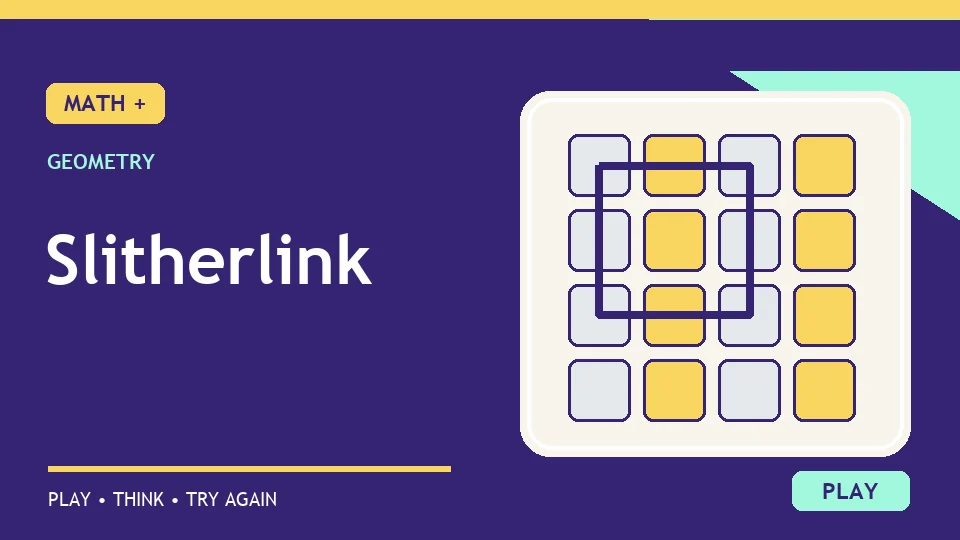
In Slitherlink, the answer is a single closed loop drawn along the edges of a square grid. A number inside a cell tells you how many of its four surrounding edges belong to the loop. A 0 touches no loop lines; a 3 touches three. Cells without numbers still influence the route because the line must pass through the grid without branching or crossing itself. The selected Guessr player opens a Practice board, and choosing an edge marks a line and increases the move count. This puzzle uses a board of cells, edges and corners; although it appears in the Geometry collection, its main challenge is logical deduction from the numbered boundaries.
Look for a 0. All four edges around it must stay off the loop. You can mark them as excluded if the player offers a cross or blank-edge state. A 3 needs three of its four edges, so it has only one missing edge, but you may need another clue before you know which edge is missing. A 1 needs exactly one. Avoid drawing around a 1 simply because one side looks convenient; three of its sides must remain unused. The numbers impose exact counts, and each line you place changes the options for neighbouring cells.
Adjacent numbered cells share an edge. If a line lies between them, it counts toward both clues. That makes pairs of clues more informative than one clue in isolation. Imagine a 0 next to a 3: their shared edge cannot be part of the loop because the 0 forbids it. The 3 therefore needs its other three edges. Once those are drawn, follow the emerging line at each corner to see which continuation avoids a branch. This is a useful first deduction because it turns a prohibition into three positive placements.
The finished drawing must be a single closed path. Two separate small loops are not a solution even if every numbered cell happens to have the right count. A path also cannot end at a vertex or split into three directions. At a corner of the grid lines, the final loop either passes through with two incident line segments or does not pass through at all. That vertex rule is a powerful check while solving: if one line reaches a vertex, eventually one other line must leave it; a third would create a branch.
Do not close a small circuit early if other required edges remain elsewhere. A premature loop can satisfy local clues but isolate the rest of the board. Instead, trace the open ends of your current path. Ask which end can connect to a new required edge without trapping the other. Sometimes the safe move is to leave an obvious-looking edge blank until a distant clue forces the route. A successful solve balances local number counts with the global requirement of one continuous loop.
Edges on the outside of the grid belong to only one cell, while an interior edge is shared by two. That difference can help when a clue sits against the boundary. A corner cell has two outer edges, and a 3 in a corner must use at least one of them because only two inner edges are available. A 0 in a corner forbids both outer edges and two inner ones. Reading the board's shape this way is a geometric aid to the logic, even though you do not measure angles or lengths.
At any point, count how many edges are already marked around a clue. If a 2 already has two lines, its remaining sides must be excluded. If a 2 has two excluded sides, its remaining sides must be lines. Apply the same reasoning to a 1 or 3. This simple counting is more reliable than trying to picture the whole final loop immediately. After each certain move, check adjacent clues and vertices again; a single edge can resolve several local questions.
Start a Practice board and mark only edges you can justify. If the game supplies undo, use it to revisit a hypothesis rather than treating the first guess as fixed. The move counter is feedback about actions, not proof that you are approaching the answer. It can increase after a line that will later need removal. A good goal for the first board is to explain each mark aloud: “this 0 forbids the edge”, or “this 2 already has both required sides”. Once the rules feel natural, a daily puzzle provides a fresh shared layout.
If you become stuck, scan for a clue that is almost complete, then for a vertex with one path segment and only one possible exit. Next examine any region your current line might cut off. You do not need to keep adding marks at speed. Some of the most useful progress is recognising that an edge cannot be used. An exclusion shrinks the possibilities for its adjacent clues just as surely as a drawn line does.
Slitherlink asks you to reason about boundaries: one square can have four possible sides, but the clue limits how many can become part of a larger closed outline. The Geometry games collection includes it because the answer is a path through a grid of edges and vertices. Its strongest link is also to Logic Puzzles, where rules must be combined across a board. Shikaku uses the same grid setting for a different goal: there, every cell belongs to a rectangle whose area matches its clue. Moving between the games makes the distinction clear. One partitions the inside; the other traces a boundary.
For an off-screen exercise, draw a small square grid and place a 0 beside a 3. Cross the shared edge and deduce the 3's other three sides. Then inspect the endpoints and ask which edges could continue a single loop. This exercise is not a full puzzle, but it makes the two levels of reasoning visible: the clue fixes local edges, while the loop rule fixes how those edges can connect.
Does a 3 mean three lines inside the square? No. It means three of the four edges around that cell are part of the loop.
Can the line cross itself? A valid loop does not branch or cross. Each vertex used by the path has one segment entering and one leaving.
Can I solve every clue and still be wrong? Yes. All local counts may fit while the drawing forms two separate loops. Check that there is one continuous closed path.
What if an edge is shared by two clues? A line on that edge counts for both adjacent cells. An excluded edge is unavailable to both.
The best Slitherlink moves are the ones forced by several rules at once. Count the edges, follow the path ends and keep the whole loop in view. A line that looks right beside one number must also work beside its neighbour and at the vertices where it connects.
Choose Practice. Mark edges around each numbered square, and tap a marked edge again to remove it. Connect the required lines into one closed loop without branches or separate rings.
Controls: Select grid edges to draw the loop. Tap a marked edge again to change or remove its mark.