Clock Master
Time
Climb themed peaks while answering clock, calendar and elapsed-time questions.
Some games take a moment to load. If the screen stays blank, or open it on the publisher’s site.
Timescaler turns questions about time into a climb. Choose a climber and a themed peak, then answer clock, calendar or elapsed-time questions to move forward. The selection screen leads to a sequence of time questions. This guide is about the reasoning that helps across those question types. A peak is a visual way to organise a run of problems; it does not change the meaning of an hour, a day or a month.
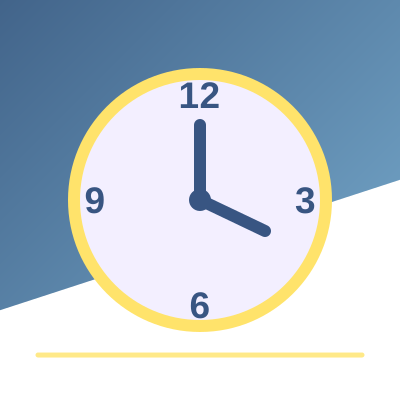
Read the short hour hand first, then the long minute hand. If the long hand points to 6, thirty minutes have passed. The short hand should be halfway between the current hour and the next one. A clock showing the short hand between 2 and 3 with the long hand at 6 reads 2:30. If the long hand points at 3, count fifteen minutes; if it points at 9, count forty-five. Count the five-minute intervals clockwise from 12 rather than treating the number under the minute hand as the minute value.
When answer choices look close, check the direction of the hour hand. At 4:50, the short hand is close to 5. At 5:50 it is close to 6. Both faces show the long hand near 10, so the hour hand distinguishes them. If the game displays a digital time and asks for a matching face, predict both hand positions before looking at the options. This reduces the temptation to choose a face because one hand happens to match.
Elapsed time asks how long passes between a start and an end. Moving from 9:35 to 10:20 is easier if you cross the hour boundary in two steps: 9:35 to 10:00 is twenty-five minutes, then 10:00 to 10:20 is twenty minutes, for forty-five minutes altogether. A single subtraction written carelessly can produce an answer such as “85 minutes” because minutes are base sixty, not base one hundred. Splitting at the hour avoids that mistake.
For a longer journey, separate full hours from leftover minutes. From 13:45 to 16:10, go fifteen minutes to 14:00, two hours to 16:00, then ten minutes to 16:10. The total is two hours and twenty-five minutes. Check the result by counting forwards from the start. When a question crosses midday or midnight, label which day each time belongs to. A finish time earlier on the clock can still be later in real life if it occurs the next day.
Time intervals can be translated into minutes when the answer options use one unit. One hour and twenty minutes is eighty minutes because an hour contains sixty. Ninety minutes is one hour and thirty. Keep the conversion explicit. Do not treat 1:20 as a decimal number; the colon separates hours from minutes, and twenty minutes is one third of an hour, not two tenths.
A calendar puzzle may ask for a date, a weekday or a gap between dates. Count from the starting date in the direction requested. If an event is three days after Monday, Tuesday is day one, Wednesday day two and Thursday day three. The starting day is day zero unless the wording says to include it. This simple convention prevents many one-day errors.
When a question crosses a month, check the number of days in that month before counting on. April has thirty days; May has thirty-one. February usually has twenty-eight, with twenty-nine in a leap year. A particular question may provide its own calendar or year, and that displayed information takes priority over a general memory rule. If it asks about a school schedule or a weekend, read the condition carefully; “three days later” and “three school days later” can lead to different dates.
The climb format may move quickly from one kind of question to another. Pause long enough to identify the unit. Are you reading a clock, measuring a duration, or counting calendar days? The same word “time” covers all three, but each has a different operation. Labelling the question type before calculating is a useful habit for mixed maths exercises.
You can use a short written line even when playing online. For elapsed time, note a start, a convenient boundary and an end: `9:35 → 10:00 → 10:20`. For a calendar count, mark day one and day two rather than jumping directly to a guess. For a clock face, say “hour near three; minute hand at nine; 2:45.” The line or spoken explanation makes it easier to detect an off-by-one or a reversed hand.
If you choose a wrong answer, inspect the question again before starting the next climb step. Did you count the starting day as day one? Did you subtract 45 from 10 as if the clock were decimal? Did you overlook a.m. and p.m.? A wrong answer is not evidence that every time skill is weak. Find the exact interpretation that failed, and the next question becomes a focused retry.
Timescaler is one member of the Time games collection. Clock Master concentrates on reading and setting an analogue clock, while Timescaler moves among several time topics. If the story around a duration is the difficult part, Word Problems offers practice in translating a sentence into quantities and operations. The links are there to help you choose the next skill, rather than repeat the same paragraph on every game page.
Why can I not subtract times like ordinary decimals? Because sixty minutes make an hour. From 9:45 to 10:15 is thirty minutes, not a decimal difference of 0.70.
What if the end time looks earlier? Check whether the question crosses noon or midnight. Place the two times on a timeline with the day labelled.
Should the starting day count in “three days after”? Usually count the following day as day one. Read the wording and any shown calendar for exceptions.
What if I only want clock practice? Choose the peak or question mode that shows clock questions if offered, or use Clock Master for a focused clock-face game.
Timescaler works best when you slow the climb just enough to name the question. Read the clock hands, break a duration at an hour, or count calendar days one step at a time. That turns a mixed series of questions into small problems you can explain and check.
Choose a climber and peak. Read each question carefully, identify whether it asks for a clock time, date or duration, and select an answer to continue.
Controls: Choose a climber and peak, then select answers as you work through the time questions.