Battle Math
Subtraction
Set the decimal precision and operations, then solve timed decimal arithmetic questions by typing each answer.
Some games take a moment to load. If the screen stays blank, or open it on the publisher’s site.
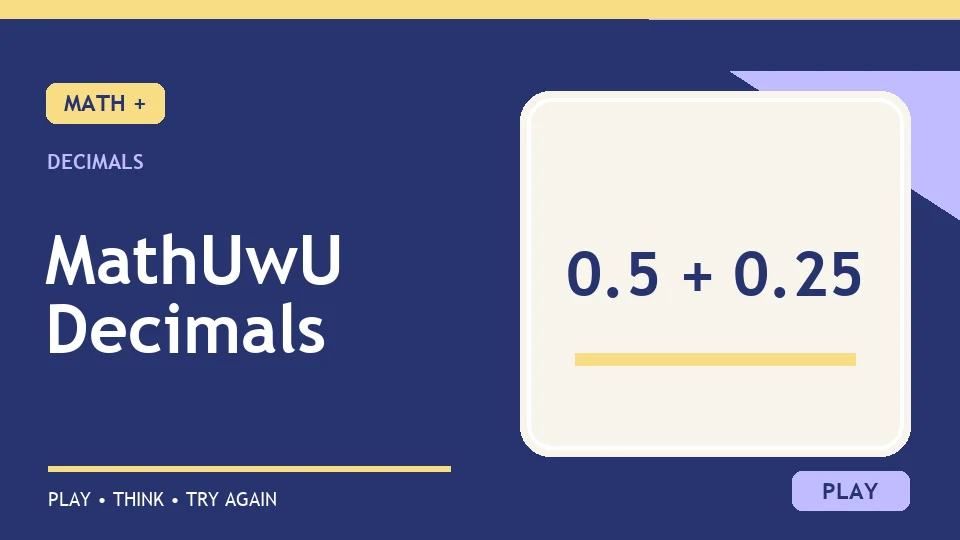
MathUwU Decimals is a timed arithmetic game in which the numbers include decimal places. The player chooses the decimal precision and operations, starts a round, types an answer and presses Return. Its settings offer addition, subtraction, multiplication and division, so a round can focus on one operation or combine several. For learning, the most useful choice comes before the timer starts: select the operation and precision that fit what you want to practise, rather than treating every decimal calculation as the same skill.
Decimal precision changes the kind of thinking a question demands. Tenths are often manageable by thinking in ten equal parts of one whole. Hundredths add a second place, so it helps to recognise that 0.35 means thirty-five hundredths, or three tenths and five hundredths. Before pressing Start, inspect the game's precision setting and make a deliberate choice. If you are new to decimals, practise tenths with one operation. When the place values feel familiar, add more places or more operations. Keeping the settings stable across two rounds gives you a fairer sense of progress than changing everything after each attempt.
A timed game can be energetic without becoming a guessing exercise. Read each number completely, including the digits after the decimal point. When a question shows 0.4 and 0.04, the zero between the point and four matters: the first is four tenths, while the second is four hundredths. They are not interchangeable. Say the place value silently before calculating if a small-looking digit tempts you to rush. Speed comes from recognising the quantities, not from ignoring the decimal point.
For decimal addition, line up place values. In 1.25 + 0.4, rewrite 0.4 as 0.40, then add to reach 1.65. The extra zero does not change the value; it makes the hundredths column visible. For subtraction, use the same alignment: 2.00 − 0.75 = 1.25. An estimate can check the typed answer. If you subtract a number smaller than one from two, the answer should still be between one and two. Entering 12.5 would be a sign that the decimal point moved.
The game lets you select operations, so isolate addition or subtraction when either one is causing mistakes. A mixed round asks you to recognise the symbol as well as align digits. For a question such as 3.6 − 1.2, subtract twelve tenths from thirty-six tenths to reach twenty-four tenths, or 2.4. This approach makes the calculation feel like whole-number subtraction while preserving the unit. Once it is comfortable, try calculations that cross a whole, such as 2.1 − 0.8 = 1.3. Work out the answer before you type it, then check the screen feedback.
Decimal multiplication can be checked with an estimate. For 0.5 × 8, half of eight is four. For 1.2 × 3, three groups of one and two tenths make 3.6. If you get 36, you have likely lost the scale of the number. You can also multiply as whole numbers and restore place value: 12 × 3 is 36, and 1.2 is ten times smaller than 12, so the answer is 3.6. This reasoning is more reliable than memorising a rule about moving a point without knowing why.
Division works in the opposite direction. For 3.6 ÷ 3, three equal shares each contain 1.2. Check by multiplying 1.2 × 3 to get 3.6. For 0.8 ÷ 4, eight tenths split into four groups of two tenths, giving 0.2. If the game's settings mix operations, read the symbol before choosing a method. Multiplication and division can share the same numbers yet require very different answers.
The score rising after a correct answer shows that the typed result was accepted. It does not explain which method you used. After a round, recall one question that felt slow and work it through without a clock. Was it reading a hundredth, subtracting across a whole, or remembering where the point belongs after multiplication? Keep a short list of such stumbling blocks. A second round with one operation selected can show whether the method improved. If you make a typing error, separate it from a maths error; the two need different practice.
It is reasonable to pause or stop after a short session. Timed decimal drills are one form of learning, not the whole subject. A place-value grid, coins or a number line can help when the positions of tenths and hundredths still feel abstract. Return to the game after you can explain a sample calculation in words. The goal is to enter a result you understand, rather than to chase the score by trial and error.
MathUwU Decimals sits in Decimals games because decimal numbers are present throughout the selected mode. Battle Math also has a decimal setting, but its Free Play structure is different. If basic calculations need work before adding decimal places, the Mental Math games collection offers whole-number practice. Do not assume a shared category means identical controls or difficulty: inspect each game's own setup.
Can I practise only decimal subtraction? The settings allow an operation choice. Select subtraction before starting and check that the questions use the operation you intended.
Why is 0.4 different from 0.04? The four in 0.4 is in the tenths place; in 0.04 it is in the hundredths place. Four tenths are ten times four hundredths.
How do I enter an answer? Type the number and press Return. Check your decimal point and sign before submitting.
Is a faster answer always better? Only when it is also correct. If a timer encourages repeated mistakes, choose a simpler precision or a single operation and practise the method first.
MathUwU Decimals is a compact way to revisit arithmetic with decimal values. Choose the setting, read the place values, estimate the size of the result, then type and submit. A correct score is satisfying; an answer you can explain is the stronger result.
Choose decimal precision and the operations to practise, press Start, calculate each question, type the answer and press Return.
Controls: Choose the settings, type a numerical answer and press Return to submit it.