Fraction Pizzeria
Fractions
Compare two fractions and choose the larger value or Equal, using the game's visual explanations to check your answer.
Some games take a moment to load. If the screen stays blank, or open it on the publisher’s site.
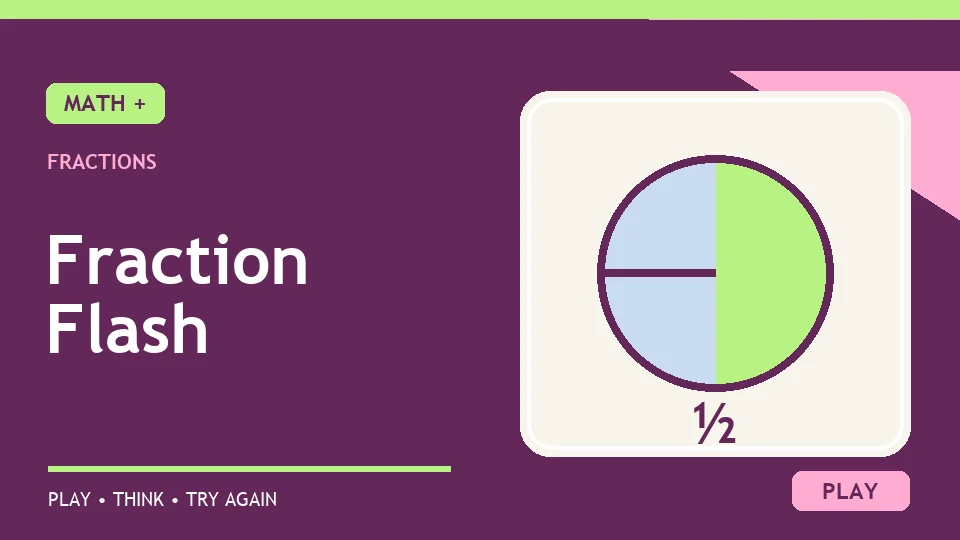
Fraction Flash is a browser game about comparing two fractions. Two cards appear; choose the larger value, or choose Equal when the values match. The publisher describes pie charts, bars and decimal explanations as part of its feedback. In the Learn setting, questions such as 3/6 against 2/6 or 8/9 against 2/9 provide a useful starting point. Those examples share a denominator: when the pieces have the same size, the fraction with more pieces is larger. The game becomes more interesting when the parts are different sizes and the numerator alone cannot decide the answer.
The top number is the numerator, telling you how many equal parts are being counted. The bottom number is the denominator, telling you how many equal parts make one whole. A bigger numerator does not always mean a bigger amount. For example, 3/8 is smaller than 1/2 even though 3 is bigger than 1. Three eighths are three small pieces; one half is four eighths. To compare the two, use the same-sized pieces, a picture, or a common denominator. Fraction Flash asks for that comparison repeatedly, with quick feedback after each answer.
When the denominators match, compare numerators directly. For 3/6 and 2/6, both wholes are split into sixths; three such pieces cover more than two. When numerators match, the smaller denominator usually gives larger pieces: 1/3 is bigger than 1/5. These rules are useful, but read both numbers first. If you see 2/3 next to 3/5, neither shortcut settles the question on its own. Convert to fifteenths: 2/3 is 10/15 and 3/5 is 9/15. Then 2/3 is larger.
The publisher's pie charts and bars are there to make the size of a fraction visible. Imagine a bar divided into four equal sections with three shaded: that is 3/4. A second bar divided into eight with five shaded is 5/8. Looking at aligned wholes, you can see that three quarters cover more length than five eighths. You can also calculate 3/4 = 6/8, which is greater than 5/8. A picture is not a decorative hint; it is another representation of the same number. Use it to test the result you found mentally.
Always compare wholes of the same size. A small pizza cut into halves and a large pizza cut into quarters cannot be compared by counting slices without stating the whole. The fraction describes a share of its own whole. In the game, read the numerical cards first, then use the visual bars or pies to check whether your intuition matches the actual portion. If a picture and your calculation seem to disagree, revisit the denominator. That is often where the misunderstanding sits.
Equal fractions can have different-looking numerators and denominators. One half and two quarters cover the same amount; multiplying both numbers in 1/2 by two gives 2/4. The same idea gives 3/6 and 4/8. You can simplify a fraction or draw the shares to check equality. Do not assume that unequal-looking cards must have a larger and smaller one. The Equal option exists because equivalent fractions are part of the challenge.
Try a quick test before selecting. Can one fraction be simplified? Is either one clearly one half, one whole, or close to zero? For 6/8 and 3/4, divide the top and bottom of 6/8 by two; both are 3/4. For 4/6 and 2/3, the same step reveals equality. If simplifying is not obvious, draw two bars with the same length and divide each into its stated number of parts. This is slower than guessing but helps you recognise an equivalent pair when it appears again.
The Learn level is a sensible place to begin because it gives room to inspect the cards. In the first level, the comparisons with equal denominators let a player practise the fundamental idea of more or fewer equal parts. Once that is comfortable, try a setting that shows more varied denominators if the game's menu offers it. A fast round can make familiar comparisons lively, but speed should follow understanding. If you keep tapping the fraction with the larger numerator, slow down until you can say why its value is actually larger.
A useful practice routine is to name the relationship before answering: same denominator, same numerator, equivalent, or different denominators. Then choose a method. For different denominators, build equivalent fractions; for a familiar benchmark, compare each side with one half. For example, 3/7 is below one half because half of seven is 3.5, while 4/7 is above it. This avoids unnecessary multiplication. If both fractions are close, use a common denominator or the picture. After the game explains an answer, try to reproduce the comparison without looking at the explanation.
Fraction Flash belongs in Fractions games because every decision is about fraction size. Fraction Pizzeria uses fractions for a different action: covering pizza slices to match an order. It also introduces percentage orders; the Decimals games collection offers a related way to compare parts of a whole. These activities complement each other. One asks you to compare values, while the other asks you to make a specified share. Playing both can reveal whether you understand a fraction only when it is written as numbers or also when it describes part of an object.
The game's title does not mean it is a printable flash-card set. This is an interactive browser comparison game: two fractions appear on screen and you choose between them. A player looking for a direct question-and-answer round can start here; someone wanting physical cards can use a printable resource instead. The name is similar, but the activity and its controls are different.
How do you compare fractions with the same denominator? Compare the numerators, because each piece is the same size. In an 8/9 versus 2/9 example, eight ninths are larger.
What if the denominators differ? Use a common denominator, a picture with equally sized wholes, or a benchmark such as one half. Checking only the top number is unreliable.
Can two different-looking fractions be equal? Yes. Fractions such as 1/2 and 2/4 represent the same share. Choose Equal when the values match, even if the printed numbers differ.
Fraction Flash is most useful when each answer has a reason. Name the pieces, check the whole, and use the visual explanation to connect the symbols with an amount. Repeating that process is what turns a quick choice into reliable fraction sense.
Open Learn, read both fractions and choose the larger value or Equal when they match. Use the pie, bar and decimal feedback to understand the comparison before moving on.
Controls: Select either fraction card or Equal. Use the game's feedback to check the comparison.