Playpager Sudoku
Sudoku
Solve a compact 6 × 6 Sudoku grid in a shared daily puzzle or extra Practice boards.
Some games take a moment to load. If the screen stays blank, or open it on the publisher’s site.
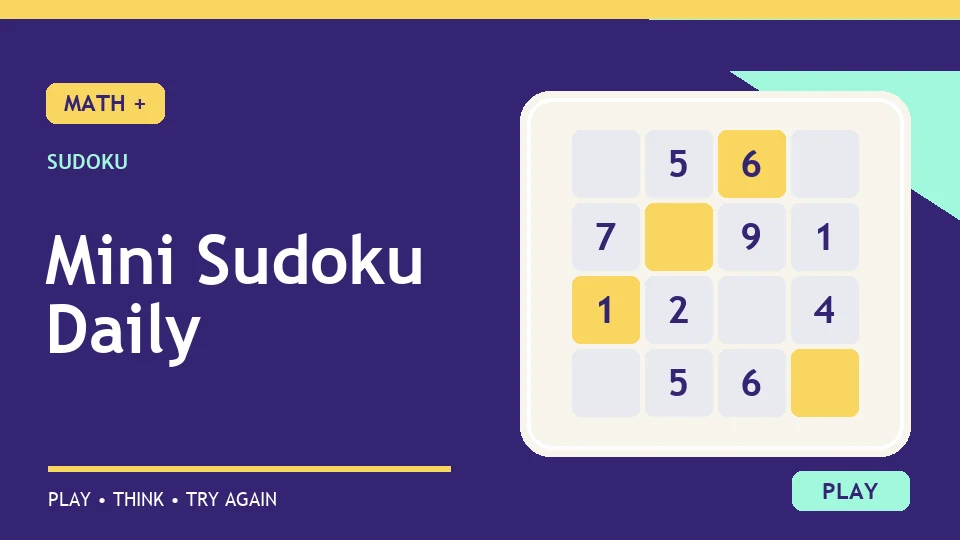
Mini Sudoku Daily takes the familiar Sudoku idea and fits it into a 6 × 6 grid. Use the digits 1 to 6 so that each row, column and marked region contains each digit once. The smaller board is quick to inspect, which makes it approachable when a full 9 × 9 puzzle feels like too much. The publisher supplies one shared daily puzzle and extra Practice boards. That gives you two ways to play: compare your approach to today's grid, or repeat the basic logic as often as you want in Practice.
Before entering a number, inspect its row, its column and its region. A candidate is legal only if it is absent from all three. On a 6 × 6 board, a row with `1, 2, 3, 4, 5` already showing has one missing value: 6. If a row shows `1, 2, 4, 6` with two blanks, it needs 3 and 5. Look at the columns and regions of those blanks to decide which gets which. This is the same kind of elimination used in regular Sudoku, but the smaller digit set makes the possibilities easier to track.
Do not assume the region shape from another Sudoku game. Look at the lines drawn on this board. A six-by-six game commonly uses six-cell regions, and the displayed boundaries tell you exactly which squares belong together. The rule is about the marked region in front of you, not a memorised 3 × 3 square from a nine-by-nine puzzle. When checking a possible entry, trace those boundaries and count the existing digits inside them.
An entry can be wrong without creating an obvious row duplicate if you forgot the region. Suppose a 4 is absent from a row and column but already present in the same marked region. It cannot go in that square. Conversely, a number missing from a region can sometimes be placed only in one of its blanks because the other blanks share rows or columns where that number is already used. These are small, explainable deductions. They are more reliable than entering a digit because the pattern looks balanced.
Start with an area that has many printed clues. A nearly complete row can reveal a missing digit. A region with two gaps may be even more useful if one of its missing digits is blocked in one gap's column. Fill that forced square and recheck the surrounding areas. One placement often creates a new nearly complete row or region. The solution develops through these connected observations; it need not be found in one sweep.
If nothing has a single blank, write or think through the candidate set for one square. Remove the numbers already present in its row, column and region. Then compare it with a neighbouring blank. For example, if two squares in the same row can only hold 2 and 5, those two digits are reserved for those squares. Another blank in that row cannot be 2 or 5. This reasoning can help without guessing which of the pair gets which digit immediately.
The game offers a mistake check and Undo. Use them as feedback, not as a substitute for inspecting the board. If a move is marked incorrect, undo it, then identify the row, column or region constraint that was missed. If you cannot see the conflict, examine the printed region boundaries and the neighbouring clues again. A wrong move is most useful when it teaches you what to inspect on the next board.
The daily grid is the same for everyone worldwide, according to the publisher. It resets with a new board, while Practice offers more puzzles without waiting for tomorrow. You can begin with an Easy Practice board to learn the controls and then try the daily puzzle. The published description mentions a clock and streak, but neither is required for learning Sudoku. A careful completion is more informative than a fast sequence of unchecked entries.
Choose a board to open the puzzle and its number controls. Select an empty square, choose the intended digit, and inspect how that entry changes the rest of the grid. If you are using a touchscreen, make sure the selected square is the one you meant before choosing a number. A small board can invite quick taps; slow down when two adjacent cells are open. After placing a digit, scan its row, column and box before moving to the next square.
A six-by-six Sudoku can teach the same reasoning habits as a larger board: check three overlapping areas, list missing digits and place a value only when the evidence supports it. The smaller format makes it easier to see the consequence of each move. It is a good introduction for a child who knows numbers to six, and it can be a short logic break for an adult. The puzzle does not test addition or multiplication speed. It tests attention to constraints.
When you are ready for more squares, try Playpager Sudoku from the Sudoku games collection. Its 9 × 9 grid uses digits 1 to 9 and 3 × 3 boxes. For a different kind of number-grid reasoning, Number Puzzles includes Hidato and sequence games. Linking to another collection is useful only when you understand the changed rule: in Hidato, consecutive values must touch; in Sudoku, each row, column and region must avoid repeats.
Does Mini Sudoku Daily use digits 1 to 9? No. This selected version has a 6 × 6 grid and uses 1 to 6.
Can the same digit appear twice on the board? Yes, in different rows, columns and regions. It cannot repeat inside any one of those areas.
Should I restart after a mistake? Usually not. Undo the incorrect move, locate the overlooked constraint and continue. The board can still teach you something.
Will Practice show today's exact grid? Practice supplies extra boards; use the daily mode for the shared puzzle. Do not rely on a particular Practice layout staying the same.
Mini Sudoku Daily keeps the rules small enough to hold in view while giving every move a reason. Check the row, column and marked region, use feedback thoughtfully, and let one certain placement reveal the next. The daily board can be a pleasant ritual; Practice gives you the room to learn at your own pace.
Choose the daily board or an Easy Practice puzzle. Fill the 6 × 6 grid with digits 1 to 6, without repeats in a row, column or marked region.
Controls: Select an empty square and choose a digit with the game's controls. Use Undo or mistake feedback when needed.