
Math Tower
Multiplication
Choose tables from 2 to 12, find products on a 4 × 4 bingo card and work towards a line or blackout.
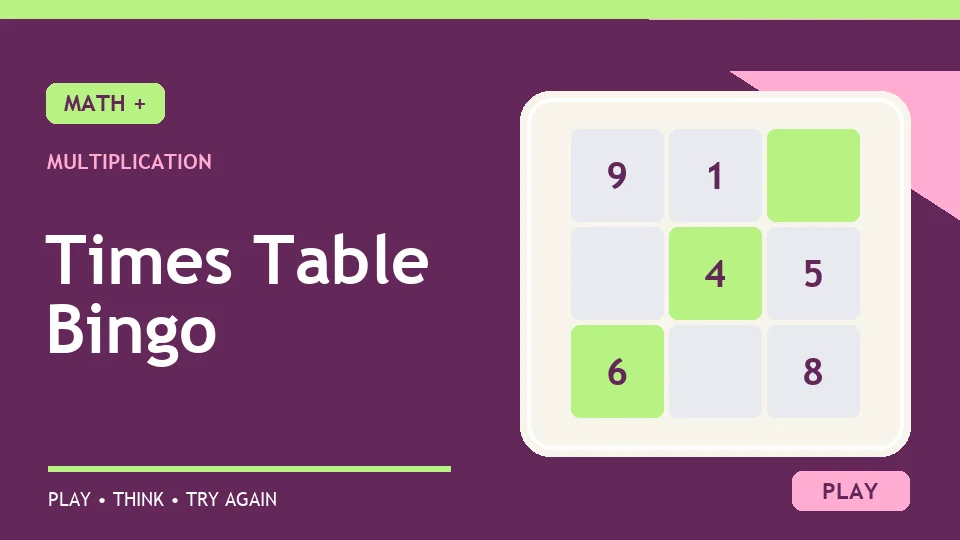
Some games take a moment to load. If the screen stays blank, or open it on the publisher’s site.
Times Table Bingo turns multiplication practice into a game of finding products on a card. Choose which times tables to include, start a round, read the calculation above the card and mark the square containing its answer. The version selected for Math Games uses a 4 × 4 grid and covers tables from 2 to 12. It offers Relaxed and Race settings, so you can decide whether to concentrate on a method or work on recall under more pressure. A completed line earns a bingo; the publisher also describes continuing towards a full-card blackout. The question is always a multiplication fact, but the card changes how you respond: you must both calculate and locate the product.
Start with a table you are learning now, rather than selecting every available table at once. The 2, 5 and 10 times tables have patterns that many players can use to gain confidence. A 2 times table answer doubles a number; a 5 times table product ends in 0 or 5; and multiplying by 10 shifts the place value of a whole number. These clues are useful because a bingo card contains several possible answers. You still need to solve the question, but you can rule out unlikely squares before selecting one.
If you know the simpler facts already, include a table that still slows you down. A round with the 6, 7 and 8 times tables asks for closer attention than a round of 2s alone. Mixed tables also help you recognise a question without relying on a fixed sequence. The point is not to choose the hardest possible setting immediately. Select a manageable set, play once, and notice which facts you had to count through. Choose the next round based on that evidence.
Suppose the question is 7 × 6. You can think of 7 × 5 = 35 and add one more 7 to reach 42. Then look for 42 on the card and select it. Another method is to reverse the factors: 6 × 7 has the same product. For 8 × 4, doubling 8 twice gives 16 and then 32. Each route arrives at a product you can search for on the grid. When a card shows the same kind of question again, try to recall the product before using the longer method.
Do not tap a number just because it looks familiar. A card can contain several products from the chosen tables, and a near miss is still a different answer. For instance, 6 × 7 is 42, whereas 6 × 8 is 48. Read both factors, calculate, then scan the card. The board gives immediate feedback, but the learning comes from working out why a square is right or wrong. If you make a mistake, say the complete equation before the next call. That small pause can stop the same mix-up from repeating.
Use Relaxed when you want time to calculate and check. It is a sensible first choice for a new table, for a younger player who is still building facts, or for a teacher demonstrating a strategy. Use Race when the facts are already familiar and you want to test how quickly you recognise products on the 4 × 4 card. A fast round is fun, but a higher score is not evidence that a method was understood. If accuracy falls sharply in Race, go back to Relaxed and isolate the facts that need more work.
You can turn a short session into a simple routine. First play one Relaxed round with a single table. Next play a mixed round with one neighbouring table added. Finally try Race with the same selection if the first two rounds were accurate. This changes one variable at a time, so you can tell whether the difficulty came from the new table or from the speed. In a classroom, different pupils can choose different tables without changing the basic rules of the game.
Completing a line rewards attention across the board. It does not mean that every multiplication fact in the selected tables has been mastered. A card can be completed through a particular sequence of calls, and some products may not have appeared yet. Continue toward blackout if you want a longer round, then look back at the facts that required repeated counting. For a more focused next session, choose those tables again and aim for fewer corrections. A useful personal goal is to answer a previously slow fact by recall or by a quick related fact.
The format is especially good for separating two skills: calculating the product and finding it among alternatives. A player might know 9 × 4 = 36 but scan the card slowly. Another might spot a familiar-looking 36 without checking whether the question was 9 × 4 or 9 × 5. Both players can improve by pausing to name the equation before selecting the square. For an untimed comparison, try Math Tower in its Multiply setting; that game asks you to choose an answer and build a tower instead of completing a card.
The Multiplication games collection groups activities that ask for products in different ways. Bingo makes repeated facts feel varied because the board and lines change. Mental Math games include quicker calculations across several operations. If you need to understand the meaning of a times table rather than memorise a sound, use equal groups: 4 × 6 means four groups of six, or six groups of four. Draw them, count to 24, and connect that count with the fact you see in the game. Arrays and repeated addition are slower than recall, but they give a way to check an answer you are uncertain about.
For a challenging fact such as 7 × 8, build from one you know: 7 × 4 = 28, then double it to 56. For 9 × 6, calculate 10 × 6 = 60 and subtract 6 to get 54. A player who can explain a result has more than a memorised number; they have a recovery method when memory stalls. Try a few such methods during Relaxed play. Race can come later, once the correct products are familiar.
Can I practise a single times table? The setup lets you choose the tables, so select the one you want to work on before starting. Check the selection on the game's opening screen if you begin a new round.
Does a line finish the game? A line counts as bingo, while the publisher also describes playing on to a full-card blackout. Follow the round's on-screen prompts and use the longer goal when you want more questions.
Is this a paper bingo game? No. This is a browser game with an interactive card. It uses the familiar idea of marking answers to complete a line, but the calculations and scoring are provided on screen.
Times Table Bingo is most useful when the table choice reflects what you need today. Read the factors, calculate the product, then mark it deliberately. If a round exposes one stubborn fact, that is a useful result: practise that fact with a method, return to the card, and see whether the next call feels easier.
Select the tables and Relaxed or Race mode, then start bingo. Read the multiplication question and mark the square showing its product. Complete a line or continue toward a full card.
Controls: Choose tables and a mode, then select the square showing each product.