
Which Group Has More?
Counting
Look at a brief dot pattern and select the number of dots from the answer buttons.
Some games take a moment to load. If the screen stays blank, or open it on the publisher’s site.
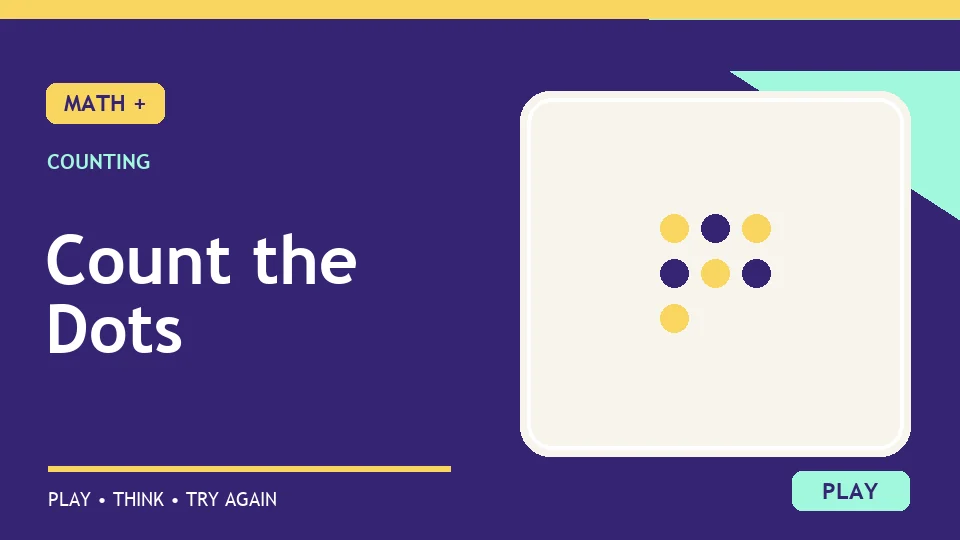
Count the Dots briefly shows a small pattern and asks you to choose how many dots you saw. The embedded practice game is supplied by Dyscalculia.io. Its publisher describes quantities from one to nine and calls the skill subitizing: recognising a small amount without counting each dot in turn. This makes it one example of subitizing games (often written “subitising” in the UK). The dots can be arranged in different ways, so a familiar pattern is helpful but not guaranteed. This guide is for the playable practice frame on this page, not for the publisher's separate screening test.
A group of three dots might form a triangle. Four might form a square, two pairs or a row. Seeing “two and two” gives four without needing to point at each dot. For a larger pattern, split it into parts: a cluster of five plus a cluster of two gives seven. The aim is not to force instant recognition at any cost. It is to find a structure that makes the quantity clear, then choose the matching number.
This ability appears in ordinary life. A die face showing five pips is usually recognised as five because its pattern is familiar. You do not need to whisper “one, two, three, four, five” every time it rolls. With a new arrangement, however, counting can be the right check. The game offers both opportunities: trust a pattern when it is clear, and use a careful count when your first glance is uncertain.
Try describing a pattern rather than only stating its total. “I saw three at the top and two below, so five.” That sentence explains what you noticed. If you answered six but the display was five, the description can reveal whether you duplicated one dot in your mind or missed the shape. For a child, an adult can ask “How did you see it?” without turning a playful round into a speed test.
Start the game and watch the dot picture. Select a number from the displayed answer buttons. The publisher's embed page describes this as a standalone practice game that gives a short well-done message after the round set. It does not show a diagnostic result and does not assess whether someone has dyscalculia. Its screening test elsewhere uses related screens, but the game here is for play. No account or medical interpretation is needed to answer a dot question.
The publisher's methodology describes five standard examples with 3, 6, 2, 8 and 4 dots in its screening sequence. The embedded practice uses the same game screens, but the provider can change their display. Do not memorise those five answers and assume the next picture must follow that list. Look at the dots that actually appear and choose from the buttons in front of you. A correct habit should work if the order, colour or arrangement changes later.
The game is short. If one picture disappears before you finish counting, use the next attempt to scan for groups instead of chasing individual dots with your eyes. You can also practise with a physical die or domino tile away from the screen. Show it briefly, hide it and ask how many were visible. A small, repeated activity often builds confidence better than a long session of hurried guesses.
The answer buttons connect a seen quantity to a written digit. A child may see “two and one” but need another moment to choose the numeral 3. This is a separate step from seeing the dots. If they choose the wrong button, ask whether the total was unclear or the digit label was mistaken. The remedy differs: practise recognising dot groups for the first problem, and matching quantities to written numerals for the second.
Numbers one through nine are small enough to test with objects. Put six counters on a table as two groups of three; the written 6 names the whole collection. Rearrange the same counters into a row and the total stays six. This shows that quantity does not depend on the picture's shape. The game changes visual patterns, but the number is about how many dots there are, not where they sit.
If you feel uncertain, count once to check and then look for a shorter description of the same amount. For eight dots, perhaps you can see two groups of four or five and three. That second look links counting to structure. It also gives you a method for patterns too large to recognise immediately. “I saw five plus three” is a valid route to eight even if you did not know it at first glance.
The Counting games collection also includes Which Group Has More?. That game compares two quantities without always requiring the exact count of either one. Count the Dots asks for one exact numeral. Mental Math begins using known quantities in arithmetic, so accurate recognition can make later sums less effortful. The links show a progression from seeing a set, to comparing sets, to calculating with numbers.
The game is supplied by Dyscalculia.io. Their embed information asks for a visible credit link and says the practice game does not score or store answers. The source is credited on this page. If the game does not load, the publisher's page can help confirm whether it is currently available.
Do I have to answer without counting? No. Fast recognition is the skill being practised, but counting is a sensible check when the pattern is unfamiliar.
Is this a dyscalculia diagnosis? No. The embedded game is practice, with no diagnostic score or result. A separate screening tool exists on the publisher's site.
Why learn several ways to see six dots? The quantity stays six when the arrangement changes. Grouping helps recognise it without relying on one memorised picture.
Is there another version on a phone? The publisher links to Dyscalculia: Numeracy & Math on Google Play. That Android app includes the same five number exercises but is a separate product with its own purchases and progress. No matching App Store link has been verified.
Count the Dots gives you a tiny question with a useful habit behind it: see a group, name its size and explain the pattern that helped you know. There is no need to race. A clear “three and two make five” is a strong answer whether it came instantly or after a careful second look.
Start the practice round, observe the dot pattern and choose the number that matches it. Try seeing groups before counting one by one; this embedded practice is not a diagnostic test.
Controls: Tap or click the numeral that matches the dot pattern.