
Count the Dots
Counting
Compare two dot groups and select the side with the greater quantity.
ONLINE GAME
Which Group Has More?
Press Play to load this game from its publisher. About game storage
Some games take a moment to load. If the screen stays blank, or open it on the publisher’s site.
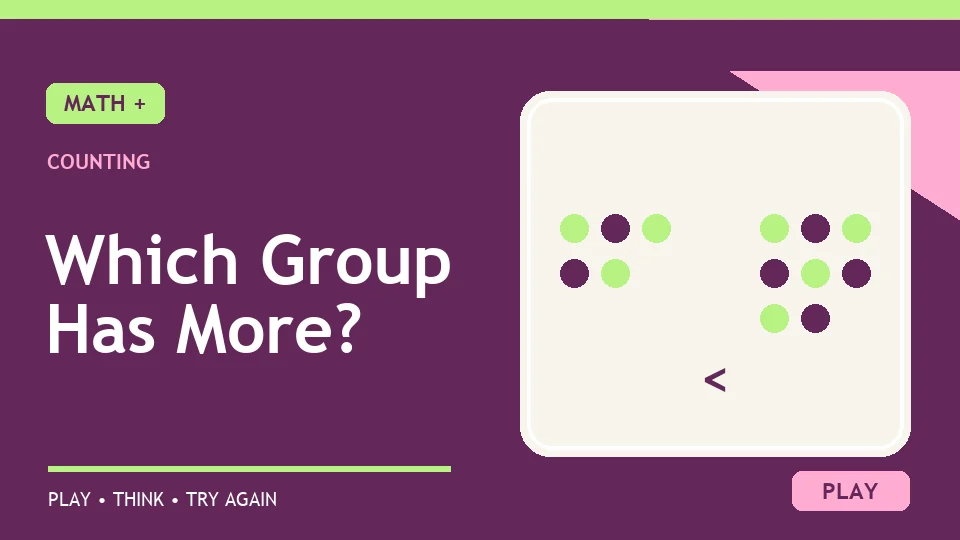
Which Group Has More? places two dot collections side by side. Choose the collection with the greater quantity. This is the Dyscalculia.io practice embed, separate from the publisher's screening result. The question is deliberately different from Count the Dots: you need to decide which side is larger, but you may not need the exact total on either side. A comparison can often be made by matching dots, noticing the size of groups or counting when two sides are close.
A scattered group can cover more of the screen than a tightly packed group while containing fewer dots. Count or estimate the dots themselves, not the empty space between them. If the left side shows three dots spread far apart and the right shows five clustered together, the right has more. The visual footprint is irrelevant. This matters outside the game too: objects arranged in a long line can look “bigger” than the same number arranged in a small cluster.
One powerful method is one-to-one matching. Imagine drawing a line from each dot on the left to a dot on the right. If every left dot gets a partner and the right still has unmatched dots, the right side has more. You do not need to know the exact totals to prove the comparison. For instance, if the left has seven dots and the right eight, the seven matched pairs leave one extra dot on the right. The remaining dot gives the answer immediately.
The matching method is especially useful when the groups are close in size. A quick visual estimate works well for two versus six, but eight versus nine can look almost equal. In a close round, slow down and compare carefully. The publisher's methodology includes five screening pairs ranging from 3 versus 7 to 18 versus 22; the embedded practice uses related screens without the screening score. Those examples show why both easy and close comparisons matter. Use the dots actually displayed rather than memorising a fixed sequence.
“More” means a greater number of dots. “Fewer” means a smaller number. Equal means both sides contain the same number, even if their arrangements look different. Choose the side with more; follow the controls it shows rather than assuming it always offers an equality option. If a pair appears tied, count or match carefully and read the game prompt again. Do not click a side solely because its dots are larger or more widely spaced.
Try a made-up comparison: the left has two rows of four, and the right has five dots plus two. Left is eight; right is seven, so left has more. Another route avoids full counting: make seven pairs, leaving one extra on the left. Both explanations are sound. These examples are for practising a method, not a list of promised rounds in the game.
A second example shows why shape can mislead. Put six dots in a single wide row and seven in a compact pattern. The row may appear longer, but the seven-dot set has more. Ask which conclusion is supported by quantity rather than appearance. A child can point to matched pairs or name two subgroups on each side. The conversation builds a reasoned comparison instead of a fast tap made from visual size alone.
Start the embedded round, inspect the left and right groups, then tap the side with more. The publisher says its embeddable practice games show no score or diagnostic result and do not store answers. When the set ends, you can play again. This is not a test of a person's ability or health. It is a short opportunity to practise judging quantity. Parents and teachers can let the player explain a choice after a round without turning every tap into an assessment.
Use a three-stage routine. First, glance at both sets for an obvious difference. Second, if the gap is small, match dots mentally or count each side. Third, check that your finger or pointer selects the intended side. This last step matters on a phone where two answer areas may sit close together. If the answer areas look close together, pause and check which side your tap selected.
If you choose the smaller group by mistake, diagnose the reason. Did one group occupy more visual space? Did you miss a dot near the edge? Did you count a dot twice? Or did you confuse “more” with “fewer”? The fix is not always “count faster.” Sometimes a calm one-to-one match reveals the answer with less effort than two exact totals.
Make two small piles of counters, blocks or coins. Ask which has more before counting them. Then match one object from each pile until one pile runs out. The leftovers prove the answer. Change the spacing of the piles without changing their counts to show that appearance can change while quantity does not. This is an off-screen exercise, not a feature or claim of the embedded game, but it strengthens the same number-sense skill.
The Counting games collection includes Count the Dots, which asks for an exact numeral from one pattern. Which Group Has More? asks for a relation between two patterns. Addition games move on to combining quantities and counting the result. Together they move from quantity recognition to comparison and then to reasoning about number structure.
The game is provided by Dyscalculia.io, whose embed rules require a visible source credit. The publisher also offers Dyscalculia: Numeracy & Math on Google Play, with the same five types of number exercises. That Android app is a separate product and may include purchases; it is not a download of the exact browser game or a way to transfer progress. No matching iOS App Store version has been confirmed.
Do I have to count both sides exactly? No. If the difference is obvious or one-to-one matching leaves an unmatched dot, that is enough to decide which group has more.
Can a spread-out group contain fewer dots? Yes. Spacing changes appearance, not quantity.
Does the embedded round diagnose dyscalculia? No. The practice embed has no screening score or result.
What if the groups seem equal? Inspect the dots and read the available choices carefully. Do not infer equality from similar shapes alone.
Which Group Has More? is a comparison game, not a race to write two totals. Look at the sets, match what can be matched and choose the side with an extra amount. That reasoning remains useful even when the dots are rearranged, enlarged or scattered across the screen.
Start the practice round, compare both dot groups and tap the side with more. Estimate first, then match or count dots when the quantities are close.
Controls: Tap or click the dot group that has more dots.