Kakuro Mini
Addition
Play Kakurasu by selecting grid squares whose position weights match every row and column target.
Some games take a moment to load. If the screen stays blank, or open it on the publisher’s site.
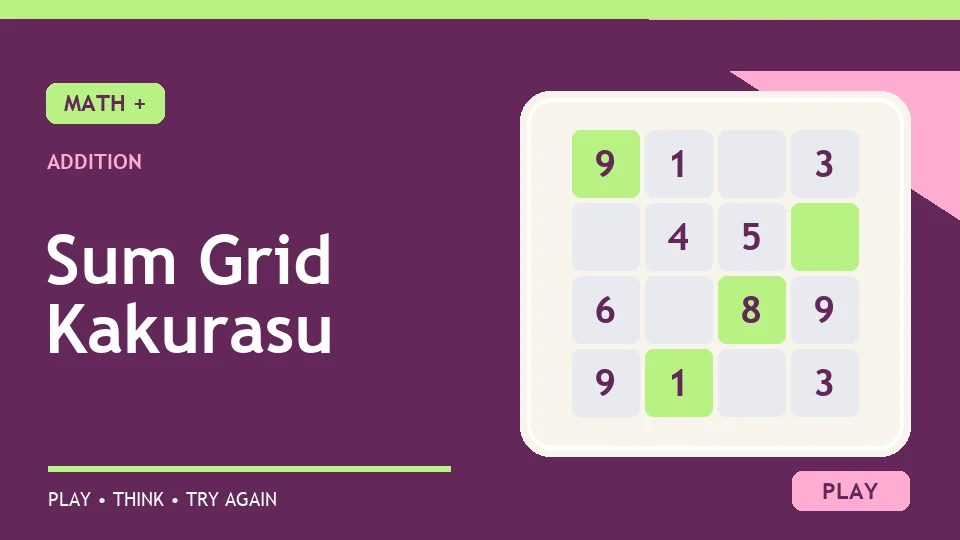
Sum Grid · Kakurasu is a number grid puzzle in which you select squares rather than type digits. Every selected square contributes to two totals: its column number counts toward the target for its row, and its row number counts toward the target for its column. Match the numbers printed at the right and bottom edges to complete the board. If you are looking for a Sum Grid Kakurasu game online, the important first step is understanding that the same square has two different weights. Once that clicks, the grid becomes a set of connected addition puzzles rather than a random pattern to shade.
The small labels across the top give the weights of columns. The labels down the left give the weights of rows. A target at the right tells you the sum required for that row; a target at the bottom tells you the sum required for that column. Selecting a square in column 4 adds 4 to its row total. If that square is also in row 2, it adds 2 to its column total. The square is a single choice, but both sums change. Dotted squares in this version are fixed, so plan around them rather than treating them as optional moves.
Consider a row with target 6. Selecting the squares in columns 2 and 4 makes 2 + 4 = 6 for that row. So would selecting columns 1, 2 and 3. Both are possible row solutions on their own, but the column targets decide which selection belongs in the finished puzzle. That is the central Kakurasu rule: never stop after matching a single row. Each choice must fit the crossing column as well.
Scan the right and bottom edges for the smallest and largest targets. A target of 0 means that no optional square in that line can be selected. This immediately removes possibilities where that row or column crosses other targets. At the other extreme, a large target may require nearly every available weight. Check the fixed dotted cells before applying either shortcut, since a board's exact options depend on which squares the game allows you to change.
Next, list short combinations for one row. If its target is 5 and the available column weights are 1 through 5, possible selections include 5 alone, 1 + 4, or 2 + 3. Compare these alternatives with the targets at the bottom. Suppose a column is already satisfied by other rows; that column cannot take another selected square. A candidate that uses it can be removed. This is more dependable than filling a row and hoping the columns resolve later.
For a column, reverse your viewpoint. Its total is made from row numbers. A square in row 4 adds 4 to that column even if it sits beneath the top label 2. Beginners often read the top number and use it for both directions. Pause after each selection and ask two questions: what did this add to the row, and what did it add to the column? The game's changing totals provide a quick check of your reading.
A completed row is only one condition. The bottom target for every column must match too. If one column is too high, remove or reconsider a selected square in that column and see which row can still reach its target another way. If a column is too low, find rows that have more than one valid combination and see whether one alternative uses that column. Avoid changing many squares at once. A single deliberate move keeps the reason for a new total clear.
Practice mode includes undo, which makes it a good place to test a deduction and then return to the previous state. The guided first game explains the weights before a larger grid asks you to coordinate them all. Guessr Games starts practice at 4 × 4 and extends it to 9 × 9; the daily board is 5 × 5. Begin with a small practice grid if you are new to this style of sum grid puzzle. A daily Kakurasu puzzle changes at 00:00 UTC, and progress is stored in the browser according to the publisher.
Both games use addition across rows and columns, but their moves are different. In Kakuro Mini you enter digits from 1 to 9, follow cross-sum clues, and avoid repeating a digit in the same line. In Kakurasu you select squares whose position numbers add to targets; you do not type a digit into every cell. This distinction matters if you arrived from a search for "sum grid" or "Kakuro" and expected one set of controls. Read the numbers at the edges and try a practice round to see which puzzle you have opened.
The Addition games collection includes more ways to work with totals. Make Ten is a quick place to practise simple combinations before returning to a grid with several linked targets. You can also explore Logic Puzzles when you want more grid-based reasoning. These links lead to related activities, but Sum Grid has its own rules: the location of a selected square supplies its value.
The embedded Kakurasu game opens directly in the browser, without an installation. In practice, select or deselect a square and watch the row and column totals change. A row that reaches its target is useful feedback, but inspect the whole board before declaring the puzzle complete. Guessr Games says you can play as a guest; official daily leaderboard results require a signed-in, unassisted finish. A hint can help you learn, although it changes leaderboard eligibility. Browser storage can keep your progress on the same device, and clearing it may remove that saved state.
If you have searched for a Kakurasu solver, try a manual check first: write the possible position weights for a target, cross out any combination that would overfill a column, and compare the remaining choices. This keeps the reasoning visible and makes it easier to learn from an error. A Kakurasu online puzzle is most satisfying when you can explain why a square is selected. The browser provides immediate totals, while the logic comes from your comparisons.
This is a thoughtful addition game for players who like a number puzzle with visible feedback. Start by reading the labels, find the restrictive targets, and make one selection you can explain. The best next move often comes from a crossing line, not from the row you were looking at first. When both directions agree, the board begins to settle. If they conflict, undo the last uncertain choice and compare the remaining combinations again. The sums are small; the challenge is making all of them true at once.
Choose Practice or the daily board. Select squares to add their column numbers to row totals and their row numbers to column totals. Match the targets at the right and bottom, accounting for fixed dotted squares.
Controls: Select or deselect a grid square; Practice mode also offers Undo.